

Open Plan Living: The Complete UK Guide
Open plan living combines kitchen, dining, and living areas into one flowing space, creating a modern home layout that maximises light and encourages family interaction. Whether you're planning an open plan kitchen living room or a full ground-floor conversion, the key to success is smart zoning, strategic furniture placement, and cohesive design that defines distinct areas while maintaining visual flow throughout the space.
Whether you're renovating a Victorian terrace, converting a period property, or designing a new-build, understanding open plan principles helps you create a functional, beautiful space that works for everyday life.
In this guide:
What open plan living means and who it suits
Benefits and challenges to consider
How to zone effectively without walls
Lighting strategies for different areas
Colour and material flow techniques
UK-specific considerations
FAQ from real homeowners
---
What Is Open Plan Living?
Open plan living removes internal walls between traditionally separate rooms—typically the kitchen, dining room, and living room—to create one large, multi-functional space. In the UK, this layout has become increasingly popular since the 1990s, with approximately 58% of new homes now featuring some form of open plan design.
The concept originated in mid-century American architecture but has been adapted for British homes, where smaller footprints and period properties present unique challenges. Modern UK open plan living often combines the kitchen-diner format with an extended living area, sometimes incorporating garden views through bi-fold doors.
Key characteristics:
Shared sight lines across multiple functional zones
Natural light flowing through the entire space
Flexible furniture arrangements
Combined heating and ventilation requirements
Unified flooring and colour palette
Also known as: Kitchen-diner, through-lounge, broken plan, great room, open concept living
---
Benefits: Why Do So Many UK Homeowners Want Open Plan?
Open plan layouts offer significant advantages for modern family life, particularly in UK homes where space is at a premium. The removal of walls typically adds between 10-15% usable floor space by eliminating hallways and transition areas.
Natural Light: Will Open Plan Make My Home Brighter?
Removing walls allows light to travel deeper into your home. In north-facing UK properties—common in terraced houses—this can transform previously dark kitchens into bright, welcoming spaces. A typical Victorian terrace gains approximately 40% more ambient light after opening up ground floor rooms.
Designer's Insight: In our experience, homeowners consistently rate improved light as the single biggest benefit of their open plan conversion—it's the change they notice most immediately and appreciate longest.
Social Connection: Can I Cook and Still Be Part of Family Life?
Cooking no longer means isolation from family activities. Parents can supervise children while preparing meals, and hosts can entertain guests without disappearing into the kitchen. Research from the UK Housing Survey shows that families in open plan homes report higher satisfaction with daily routines.
Designer's Insight: The social connection becomes especially valuable during busy weekday evenings when families previously ate in shifts.
Flexibility: What If My Needs Change Over Time?
A single open space adapts more easily to changing needs—from homework supervision to home working to entertaining. Furniture can be rearranged seasonally or as family requirements evolve without structural changes.
Designer's Insight: Consider future needs when planning your layout—what works for a young family may need adjustment as children grow, and a well-designed open plan gives you options.
Property Value: Will Open Plan Add Value to My Home?
Estate agents report that well-executed open plan conversions can add 5-10% to property values in urban areas, particularly when combined with garden access through large glazing.
Designer's Insight: The strongest value increases appear in Victorian terraces where the conversion also addresses period features thoughtfully—buyers respond to open plan that respects the character of the building.
---
Pros and Cons: What Should You Know Before Going Open Plan?
Open plan living isn't without drawbacks, and understanding these challenges helps you design around them. Many UK homeowners who rushed into knocking through walls during the 2010s have since installed partial partitions or clever zoning solutions.
Benefits | Challenges |
|---|---|
40% more ambient light in north-facing homes | 15-20% higher heating costs |
Supervise children while cooking | Dishwasher noise (46-52dB) competes with TV |
10-15% more usable floor space | Cooking odours permeate soft furnishings |
Flexible furniture arrangements | Less wall space for storage/artwork |
5-10% property value increase | Finding quiet space for work calls |
Modern, sociable layout | Requires high-powered extraction (500+ m³/h) |
Acoustics: Will Kitchen Noise Drive Me Mad?
Sound travels freely in open spaces. Kitchen appliances—dishwashers, extractor fans, food processors—compete with television and conversation.
The Science: The average UK dishwasher produces 46-52 decibels—roughly the volume of normal conversation—making evening TV difficult.
The Reality: In homes with hard flooring (tiles, wood), sound bounces and amplifies significantly.
Designer's Insight: We've found that acoustic planning must happen before the walls come down, not after—this is one of the most common complaints we hear from homeowners.
Ventilation: How Do I Stop Cooking Smells Taking Over?
Without doors to contain them, cooking odours permeate soft furnishings throughout the space. This is particularly problematic for those who cook frequently with strong spices or fry foods regularly. High-powered extraction (minimum 500 m³/h for open plan spaces) becomes essential rather than optional.
Designer's Insight: Investing in quality extraction equipment prevents the most common regret among open plan converts—nobody wants their sofa smelling like last night's curry.
Heating Costs: Will My Energy Bills Go Up?
Larger open volumes require more energy to heat. UK Energy Saving Trust estimates suggest open plan spaces typically cost 15-20% more to heat than equivalent compartmentalised rooms, though underfloor heating and zoned systems can reduce this differential.
Privacy: Where Do I Go When I Need Quiet?
Finding quiet space for work calls or focused activities becomes challenging. Families with teenagers or those working from home may find the lack of separation problematic.
Designer's Insight: Build in "retreat spaces" elsewhere in the home if fully committing to open plan living—a small snug, a well-designed bedroom workspace, or even a garden office.
Storage: What Happens to All My Wall Space?
Furniture placement and storage options decrease significantly. Shelving, artwork, and fitted storage all require wall space that disappears in fully open layouts.
Designer's Insight: Plan storage solutions before removing walls, not after—many clients underestimate how much wall space they'll miss until it's gone.
---
Zoning Techniques: How to Create Distinct Areas Without Walls
Zoning creates distinct functional areas within your open space without rebuilding walls. Effective zoning uses furniture, flooring, lighting, and vertical elements to suggest boundaries while maintaining visual connection.
Designer's Insight: The most successful open plan schemes typically include three to four clearly defined zones.
Furniture Placement: Where Should My Sofa Go?
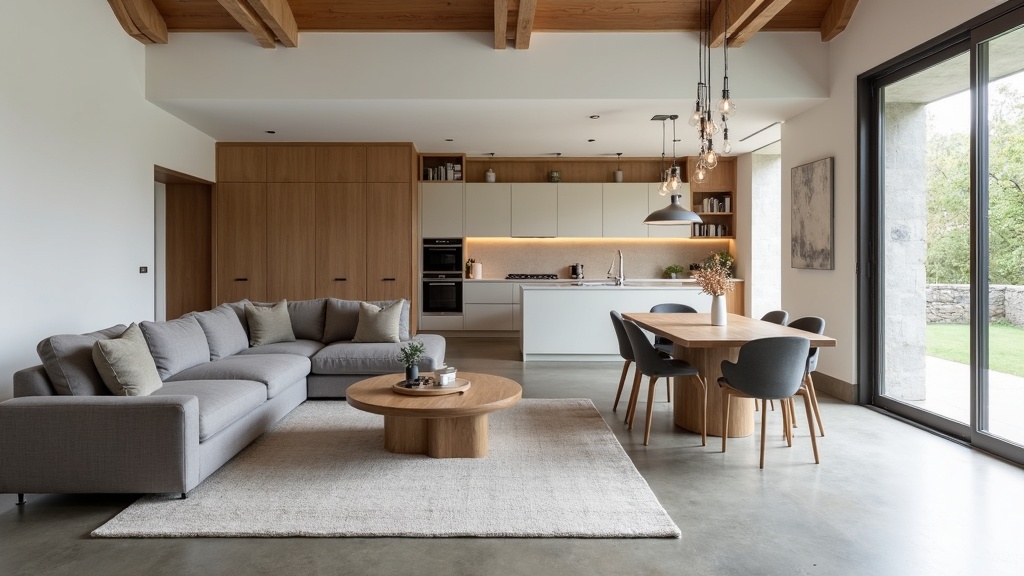
Position sofas with backs facing the kitchen to create a psychological boundary between cooking and relaxation zones. A large sectional sofa or a sofa paired with a console table establishes a clear "living room" without blocking sight lines.
Designer's Insight: Spend time with masking tape on the floor to test layouts before committing to furniture purchases—it's far easier to move tape than a three-seater.
Key principles:
Float furniture away from walls—centre-positioned sofas define space more effectively
Use rugs to anchor seating groups and dining areas
Position dining tables between kitchen and living zones as a transitional element
Consider a console table or bookshelf as a visual divider
Level Changes: Can I Use a Step or Platform to Separate Areas?
A slight step down (typically 150mm) or platform creates powerful visual separation. In UK period properties, existing level changes often occur naturally where extensions meet original buildings. Where floors are level, a raised platform for the living area adds definition while creating hidden storage opportunities.
Designer's Insight: This technique works particularly well in extensions where the new floor level can differ from the original—it turns a potential problem into a design feature.
Partial Walls: What About Half-Walls or Glass Screens?
Half-height walls (typically 900-1200mm) maintain open sight lines while providing practical benefits—hiding kitchen worktop clutter, creating seating backs, or housing electrical sockets. Glass partitions achieve separation while preserving light flow, though they require more maintenance.
Designer's Insight: Partial walls offer the best of both worlds for families who want openness with occasional privacy—and they give you somewhere to hang pictures.
Ceiling Design: Does Ceiling Treatment Really Make a Difference?
Dropped ceilings over kitchen islands or distinct paint colours overhead define zones from above. In properties with sufficient ceiling height (2.7m+), this approach proves highly effective. Exposed beams in period properties naturally suggest zone boundaries.
Designer's Insight: Ceiling treatment is often overlooked but delivers significant impact—discuss it with your designer early in the process.
---
Lighting Design: How to Layer Light in Open Plan Spaces
Open plan living requires layered lighting that serves multiple activities simultaneously. A single central light fitting—sufficient for a traditional room—leaves open plan spaces feeling flat and uncomfortable.
Designer's Insight: Plan for at least three lighting circuits controlling different zones—it's far easier to wire correctly at the start than retrofit later.
Open Plan Lighting Zones: Quick Reference
Zone | Light Type | Colour Temp | Key Tip |
|---|---|---|---|
Kitchen Worktops | Under-cabinet LED strips | 2700-3000K | Shadow-free prep; avoid glare into living area |
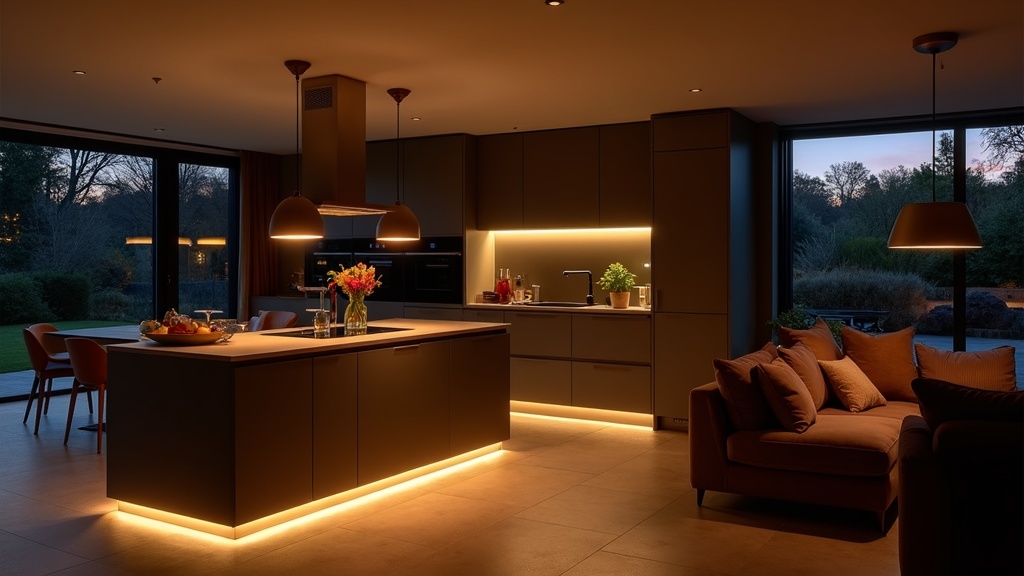
Kitchen Island | Pendant lights (750-900mm above) | 2700-3000K | Position to not obstruct sightlines |
Dining | Dimmable pendant/chandelier | 2700K | Centre over table; dimmer essential |
Living | Floor lamps + table lamps | 2700K | Triangular arrangement for balance |
Transition | Track lighting or recessed spots | 3000K | Adjustable for day/evening modes |
Task Lighting: What Do I Need Over Kitchen Worksurfaces?
Under-cabinet LED strips illuminate worksurfaces for food preparation without glaring into living areas. Pendant lights over islands require careful positioning—hang them 750-900mm above the counter to provide adequate light without obstructing views across the space. Use warm white (2700-3000K) for a comfortable atmosphere that doesn't feel clinical.
Dining Lighting: How Do I Make Dining Feel Special?
A pendant or chandelier centred over the dining table creates intimate atmosphere for meals while the kitchen operates with reduced lighting. Dimmer switches are essential—dining lighting should adjust from bright family meals to subtle evening dining.
Designer's Insight: Dining zone lighting makes the biggest difference to how the overall space feels in the evening—get this right and your dinner parties will thank you.
Ambient Lighting: How Do I Create Cosy Corners?
Floor lamps and table lamps create pools of warm light for relaxation, contrasting with the cooler, brighter kitchen illumination. Position at least three lamp sources in a triangular arrangement around the seating area for balanced, comfortable lighting.
Transition Zones: What About the In-Between Spaces?
Track lighting or recessed spotlights in transition areas can be adjusted to suit the activity—bright when the space functions as one, dimmed when zones operate independently.
Practical tip: Wire lighting circuits separately for kitchen, dining, and living zones with individual dimmers. Smart lighting systems allow scene-setting that transforms the space from daytime family hub to evening entertaining mode with a single command.
---
Colour Flow: How to Maintain Cohesion Across Zones
Colour continuity unifies open plan spaces while subtle variations help define zones. The most successful UK open plan schemes use a restrained palette of two to three main colours, with accent tones adding interest without fragmentation.
Colour Proportions: What's the 60-30-10 Rule?
Apply your dominant colour (typically walls and ceiling) across 60% of surfaces, secondary colour (larger furniture, kitchen units) across 30%, and accent colours in the remaining 10%. This proportion maintains cohesion while allowing zone differentiation.
Designer's Insight: Test paint colours in all three zones before committing—light changes dramatically across an open space, and what looks perfect in the kitchen may read entirely differently by the sofa.
Palette Connection: How Do I Connect Kitchen and Living Colours?
Kitchen cabinetry colour often anchors the palette. If kitchen units are a strong colour (navy, forest green, charcoal), echo this in living zone accents—cushions, throws, or a feature chair. If the kitchen is neutral, introduce colour more freely in the living zone while maintaining wall colour consistency.
Flooring Continuity: Does My Flooring Need to Match Throughout?
Running the same flooring throughout is the single most effective unifying technique. In UK homes, engineered wood or large-format tiles (600x600mm or larger) create seamless visual flow. Changing flooring materials between zones, while sometimes practical, visually fragments the space.
Designer's Insight: This is the one decision that's hardest to change later—get flooring right first, and everything else becomes easier.
Material considerations:
Wood flooring: warmer, acoustically softer, requires more maintenance near kitchen
Tile or stone: practical for kitchen areas, cooler underfoot, pairs well with underfloor heating
Polished concrete: industrial aesthetic, excellent thermal mass, hard underfoot
Feature Walls: Can I Still Have One?
Limit feature walls to one per open plan space—typically behind the television or as a kitchen splashback. Multiple accent walls compete for attention and destroy the unified feel that makes open plan successful.
---
Property Guide: Open Plan in Victorian Terraces vs New Builds
British homes present specific challenges and opportunities for open plan living. Period properties, typical plot depths, and climate considerations all influence successful design.
UK Property Types: Quick Reference
Property Type | Best Approach | Key Consideration |
|---|---|---|
Victorian/Edwardian Terrace | Side-return extension + through-room | Check if chimney breast is structural |
1930s Semi-Detached | Remove dining room wall + rear extension | Use bay window for zone definition |
New Build | Add character through lighting/furniture | Acoustic treatment often needed |
Victorian Terraces: What Should I Consider?
The classic two-reception-room terrace offers excellent open plan potential. Removing the wall between front and back reception rooms creates a through-room with natural light from both ends. Many owners extend into the side return or rear garden, creating an L-shaped or rectangular open plan.
Designer's Insight: We've worked with numerous terrace conversions and find the side-return extension particularly effective for adding kitchen space while preserving the front room's character.
Key considerations:
Chimney breasts may be structural—consult a structural engineer before removal
Period features (cornicing, ceiling roses) add character worth preserving
Narrow plots (typically 4-5m) require careful furniture scaling
Existing floor level changes may need addressing
1930s Semi-Detached: What Are the Best Approaches?
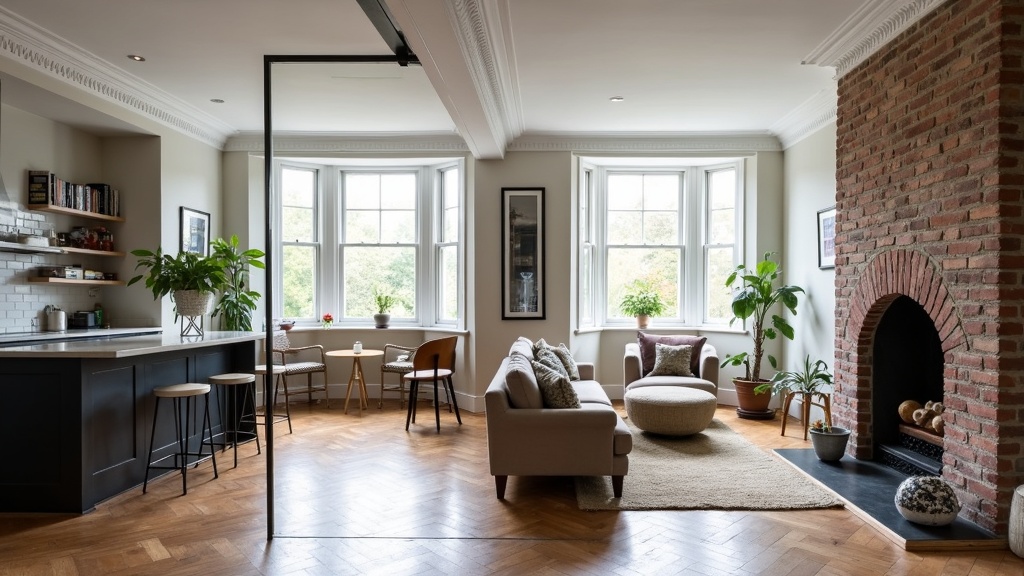
Generous room sizes and good ceiling heights (often 2.7m) suit open plan conversion well. The typical layout—bay-windowed front room, separate dining room, small kitchen—transforms effectively when walls are removed and extended into the garden.
Designer's Insight: We've seen these properties convert beautifully when the original bay is used to define the living zone.
Key considerations:
Bay windows provide useful zone definition
Original parquet flooring, if present, adds character
Rear extensions benefit from rooflights to counteract lost windows
New Builds: Are They Easier or Harder?
Purpose-designed open plan in new builds typically works well from a structural perspective but may lack character. Standard ceiling heights (2.4m) and generic finishes benefit from thoughtful lighting design and quality furniture to add personality.
Designer's Insight: The challenge with new builds is creating warmth and character where none exists—furniture choices matter more here than in period properties.
Key considerations:
Limited floor area makes zoning more challenging
Acoustic treatment often needed due to lightweight construction
Integration with garden space maximises perceived size
---
Acoustic Solutions: How Do I Actually Live With the Noise?
Addressing the acoustic challenges of open plan living requires a combination of physical solutions and behavioural adjustments. Complete silence is impossible, but reducing disturbance to acceptable levels is achievable.
Soft Furnishings: Will More Rugs and Cushions Help?
Upholstered furniture, curtains, rugs, and cushions absorb sound energy. In open plan spaces, aim for more soft furnishings than you might typically include—a large rug under the seating group significantly reduces echo. Heavy curtains at windows and on room divider tracks provide flexible acoustic separation.
Designer's Insight: Invest in quality rugs—they deliver both style and acoustic benefits. A good rug does more work than you might expect.
Appliance Selection: What Should I Look for?
Choose the quietest available appliances for open plan kitchens—the extra cost is worth it:
Integrated dishwashers (44-46dB) run quieter than freestanding
Induction hobs eliminate fan noise from gas burner extraction
Extractors with external motors dramatically reduce kitchen noise
Refrigerators rated below 40dB become nearly inaudible
Temporary Screening: What Are My Options?
For work-from-home situations, portable acoustic panels or curtain dividers provide temporary separation. Glazed sliding doors between kitchen and living zones offer the flexibility to close off cooking noise when needed while maintaining light flow.
Designer's Insight: Pocket doors have become increasingly popular—they slide completely away when not needed, giving you the best of both worlds.
Acoustic Ceilings: Are They Worth the Investment?
Acoustic ceiling panels or tiles in the kitchen area (hidden behind a dropped ceiling) reduce sound reflection. This proves particularly effective in spaces with hard flooring throughout.
---
Frequently Asked Questions
Is open plan living cheaper to heat?
Open plan spaces typically cost 15-20% more to heat than compartmentalised rooms of equivalent total size. The larger air volume takes longer to warm and loses heat faster. However, underfloor heating works particularly well in open plan layouts, providing even warmth without radiators interrupting furniture placement. Zone controls allow heating the cooking area during meal preparation without fully heating the living zone.
Do you need planning permission to knock through walls?
Removing internal walls in a typical UK house doesn't usually require planning permission, but the work almost always needs building regulations approval. If walls are structural (supporting floors or roof above), a structural engineer must specify appropriate steel beams. Party walls shared with neighbours require a Party Wall Agreement. Listed buildings and conservation areas have additional restrictions.
What is the minimum size for open plan living?
Successful open plan living typically requires at least 30 square metres of combined floor space. Below this, zones feel cramped and the benefits of openness diminish. Most UK open plan conversions create spaces between 35-50 square metres, sufficient for comfortable kitchen, dining, and seating zones.
Can you add walls back after creating open plan?
Yes, walls can be reinstated, though this involves significant work and cost. Many homeowners are now opting for "broken plan" layouts—partial walls, glazed screens, or wide openings that offer some separation while maintaining connection. This approach provides flexibility without complete commitment to fully open living.
How do you hide kitchen mess in an open plan space?
Island units with raised backs (typically 100-150mm above the worksurface) screen cooking clutter from the living zone. Handleless kitchen cabinets with push-to-open mechanisms maintain clean lines. Dedicated utility rooms or larder spaces, increasingly common in UK new-builds and extensions, allow kitchen appliances and storage to move out of sight.
Does open plan living suit families with young children?
Open plan layouts offer excellent supervision—cooking parents can see children playing. However, noise levels increase and finding quiet space becomes challenging as children grow. Many families find open plan works well during early years but appreciate the option of separation as teenagers need study space. Designing for future flexibility with wide openings rather than complete wall removal offers a sensible compromise.
---
Wrapping Up
Open plan living transforms how UK homes function, creating light-filled, sociable spaces suited to modern family life. Success depends on thoughtful zoning through furniture placement, flooring choices, and layered lighting rather than simply removing walls. Addressing acoustic and privacy challenges through material choices and screening solutions ensures the space remains comfortable for all activities.
Quick recap: 1. Define clear zones using furniture, rugs, and level changes 2. Layer lighting with separate circuits for each functional area 3. Maintain colour and flooring continuity throughout 4. Address noise through soft furnishings and appliance selection 5. Consider flexibility for future needs
Related guides:


