

Oak Furniture UK: How to Choose Pieces That Last a Lifetime
Oak is the most popular hardwood in British furniture for good reason: it is dense enough to resist everyday wear, develops a richer colour with age, and works in settings from a farmhouse kitchen to a modern city apartment. In our current collection, we list over 290 oak pieces from UK boutique retailers, spanning dining tables, sideboards, desks, coffee tables, chairs, and shelving -- priced from under £200 to over £5,000. This guide covers what to look for, what to avoid, and how to choose oak furniture that earns its place in your home for decades.
Solid Oak vs Oak Veneer vs Oak Effect: What You Are Actually Paying For
Solid oak means the structural parts -- legs, frame, rails, and top -- are cut from real oak timber all the way through. It can be sanded, refinished, and repaired over its lifetime, which is why a well-made solid oak dining table can last 50 years or more. In our catalogue, solid and character-grade oak account for the majority of pieces, with prices starting around £200 for a side table and reaching £5,295 for a large dining table.
Oak veneer uses a thin slice of real oak bonded to an engineered board core. It looks and feels like oak on the surface but costs 50-65% less than an equivalent solid piece. Veneer also resists warping on large panels -- a real advantage for wide tabletops in centrally heated homes.
Oak effect is neither oak nor wood. It is a printed film applied to chipboard or MDF. It is the cheapest option but cannot be repaired, discolours over time, and lacks the weight and feel of real wood. We do not stock oak-effect furniture at MeetFelix.
Feature | Solid Oak | Oak Veneer | Oak Effect |
|---|---|---|---|
Material | Real timber throughout | Real oak surface on engineered core | Printed film on chipboard/MDF |
Durability | 30-50+ years | 15-25 years | 3-8 years |
Can be refinished | Yes, multiple times | No (surface too thin) | No |
Warping risk | Moderate (needs stable humidity) | Low (engineered core is stable) | Low |
Weight | Heavy | Medium | Light |
Price range | £££-££££ | ££-£££ | £-£ |
How to tell the difference in a shop or online
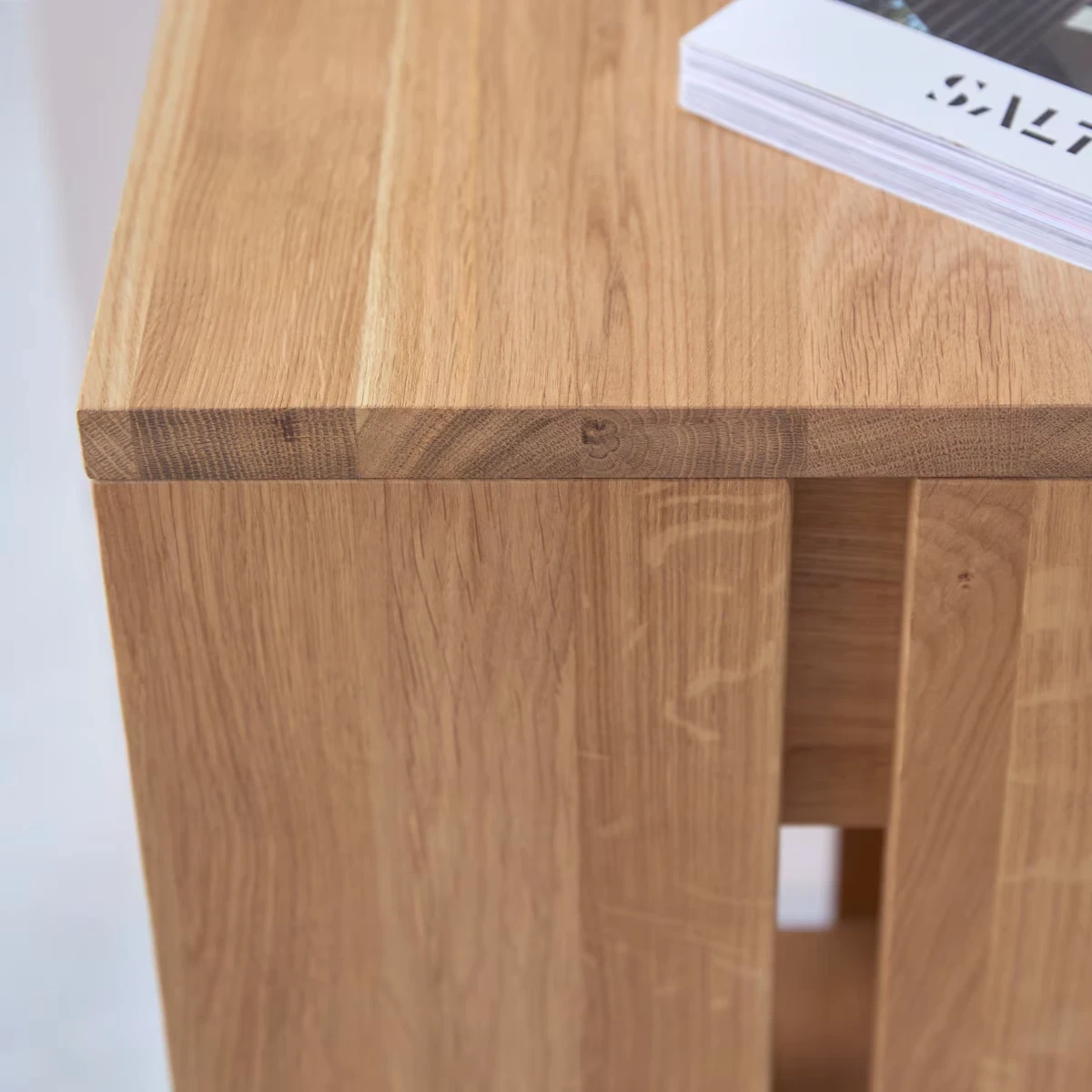
Check the edges: solid oak shows continuous grain wrapping around corners, while veneer has a visible seam where the surface meets the substrate. Online, look for terms like "solid oak frame with veneered panels" -- this is honest mixed construction and often the most practical choice. Avoid listings that say "oak" without specifying solid, veneer, or effect. If the price seems too low for the size, it is probably veneer or effect.
The Best Types of Oak for Furniture (And What the Grades Mean)
European oak (Quercus robur) is the standard for UK furniture. It has a tighter grain and warmer golden tone than American red or white oak. Most boutique UK makers source FSC-certified European oak, which balances quality with responsible forestry.
Within European oak, you will encounter different grades that affect appearance and price.
Prime grade has a clean, consistent grain with minimal knots. It suits contemporary and Scandinavian-style interiors where you want smooth, uniform surfaces. In our collection, prime oak pieces tend to sit in the mid-to-upper price range.
Character grade (sometimes called rustic grade) retains natural knots, grain variation, and occasional filled cracks. These marks are stable and deliberate -- they add personality and work well in farmhouse, industrial, and mid-century settings. Character-grade oak is often slightly cheaper than prime because it uses more of the tree.
Reclaimed oak comes from old buildings, barrels, or industrial structures. It has a weathered patina that cannot be replicated with stains. Reclaimed pieces tend to be one-offs, which makes them distinctive but harder to match if you are building a coordinated set.
Grade | Appearance | Best For | Price Level |
|---|---|---|---|
Prime | Clean, minimal knots, uniform colour | Scandinavian, contemporary, minimalist | ££££ |
Character | Visible knots, grain variation, filled cracks | Farmhouse, industrial, mid-century | £££ |
Reclaimed | Weathered patina, unique markings | Statement pieces, rustic interiors | ££-££££ (varies) |
Oak Furniture by Room: What to Buy and What to Budget
Tables and storage account for roughly two-thirds of all oak furniture in our current collection. Here is how oak works across the main rooms of a home, with realistic price expectations.
Living room
Oak coffee tables, side tables, and sideboards anchor a living room without dominating it. A solid oak coffee table starts from around £350, while a sideboard typically runs from £1,000 to £2,650 depending on size and maker.
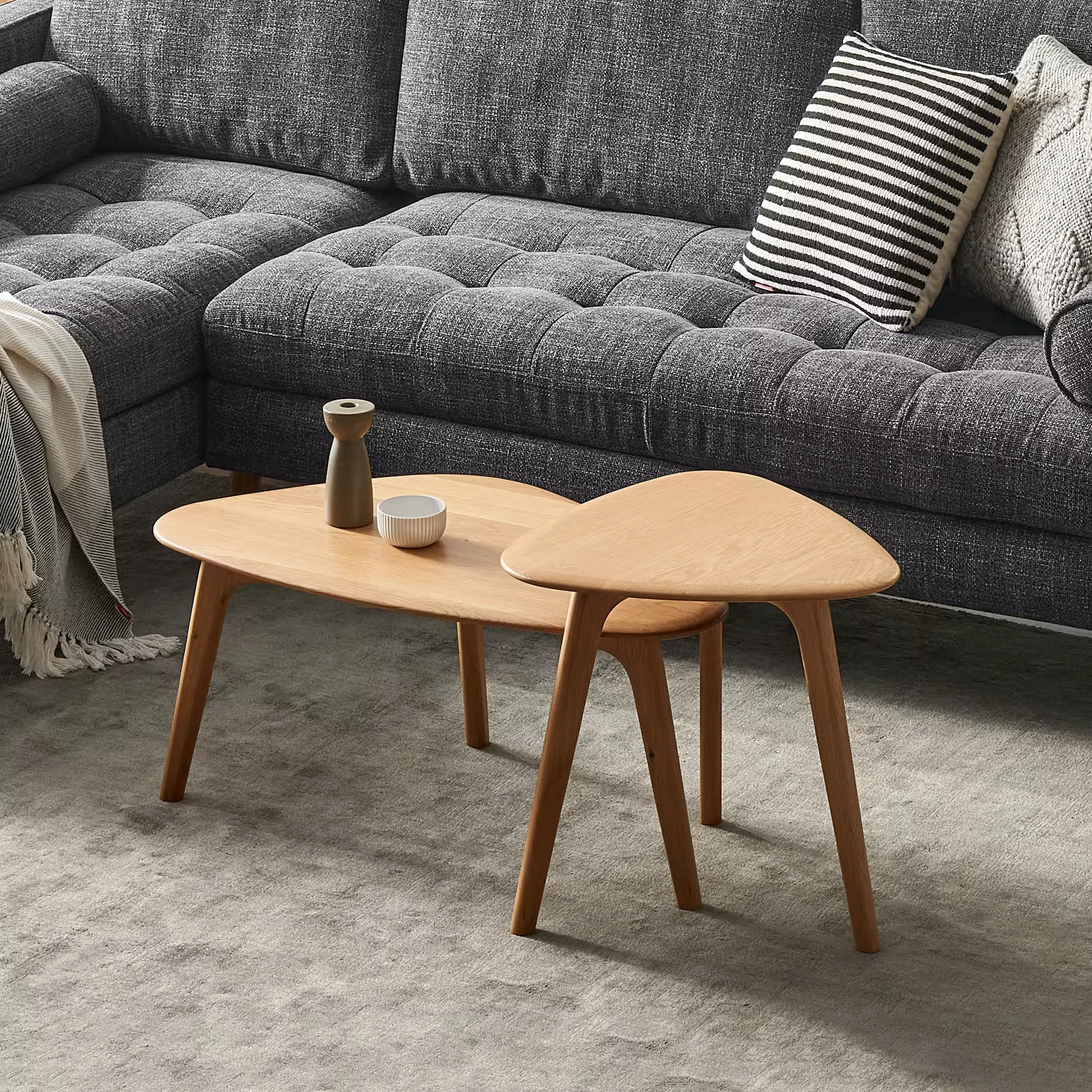
The Castlery Vincent Nest of 2 Coffee Tables in oak is a practical mid-range option at £349. The nesting design means you can pull out extra surface area when you need it and tuck it away when you do not.
For storage with presence, the Konk Teal Sideboard in oak balances clean lines with character-grade timber -- the kind of piece that improves with age.
![Teal Sideboard [Oak]](https://zpeqbrudpqjbpfhmntcb.supabase.co/storage/v1/object/public/product-images/konk-furniture/konk-furniture-tealsidebo-mjbz59ro/original/6f585769f41c.webp)
Dining room
This is where oak truly earns its keep. A solid oak dining table handles hot dishes, spilled wine, and decades of daily use better than almost any other material. In our collection, oak dining tables range from around £1,300 for a six-seater to over £5,000 for a large statement table.
When sizing, allow 60cm of table width per person for comfortable elbow room. A 180cm table seats six; 220cm seats eight. Extending tables give you flexibility without permanent bulk.
The Konk Signature Dining Table in oak is handmade in the UK from character-grade timber, with a live-edge detail that gives each table a slightly different character.
!['Signature' Dining Table [Oak]](https://zpeqbrudpqjbpfhmntcb.supabase.co/storage/v1/object/public/product-images/konk-furniture/konk-furniture-signatured-mjc1i8bq/original/a56894c03fcc.webp)
Home office
Oak desks bring warmth to a home office in a way that metal-and-laminate alternatives cannot. A solid oak desk runs from around £1,100 to £1,900 in our collection, which is more than a flat-pack option but measurably quieter to work at (the mass absorbs vibration) and far more likely to last a decade of daily use.
!['Signature' Desk [Oak]](https://zpeqbrudpqjbpfhmntcb.supabase.co/storage/v1/object/public/product-images/konk-furniture/konk-furniture-signatured-mjbzmmgb/original/125c0fa4a278.webp)
Bedroom
Oak bedside tables and dressers create a calm, grounded atmosphere. Tikamoon's Eden solid oak bedside table at £199 is one of the more accessible entry points into real oak furniture -- and pairing two matching bedside tables is an easy way to bring coherence to a bedroom without committing to a full matching set.
How to Care for Oak Furniture (And What Most Guides Get Wrong)
The single most important thing you can do for oak furniture is control humidity. Oak expands in damp conditions and contracts in dry ones. Central heating in winter can drop indoor humidity below 30%, which causes cracks and joint gaps over time. A simple hygrometer (under £10) and a room humidifier during heating season will do more for your furniture than any polish.
For oiled oak: Reapply a thin coat of furniture oil (Danish oil or hard wax oil) once or twice a year. Wipe on with a lint-free cloth, leave for 15 minutes, then buff off the excess. This replenishes the surface and keeps the grain nourished.
For lacquered oak: Wipe with a damp cloth and dry immediately. Do not use furniture spray polishes containing silicone -- they create a film that makes future refinishing difficult.
For everyday marks: Water rings on oiled oak can usually be removed with a light sand (320-grit paper, following the grain) and a fresh coat of oil. On lacquered surfaces, a dab of mayonnaise left overnight often lifts the ring -- it sounds unlikely, but the oils in the emulsion displace trapped moisture.
What to avoid with all oak: direct sunlight (causes uneven fading), placing hot items directly on the surface (use trivets), and dragging heavy objects across the top (use felt pads under lamps and accessories).
How to Mix Oak With Other Materials and Woods
One common hesitation with oak is whether it works alongside other materials in a room. The short answer: it almost always does, provided you follow a few principles.
Oak and metal is a well-established pairing. Black steel or iron legs on an oak tabletop create an industrial or mid-century feel. Brass hardware on an oak sideboard warms the piece up. In our collection, contemporary and industrial-style oak furniture accounts for a significant portion of pieces.
Oak and other woods works when you vary the tone rather than trying to match exactly. A light oak dining table with darker walnut chairs creates deliberate contrast that reads as intentional. Trying to match two similar-but-not-identical oak tones reads as a mistake.
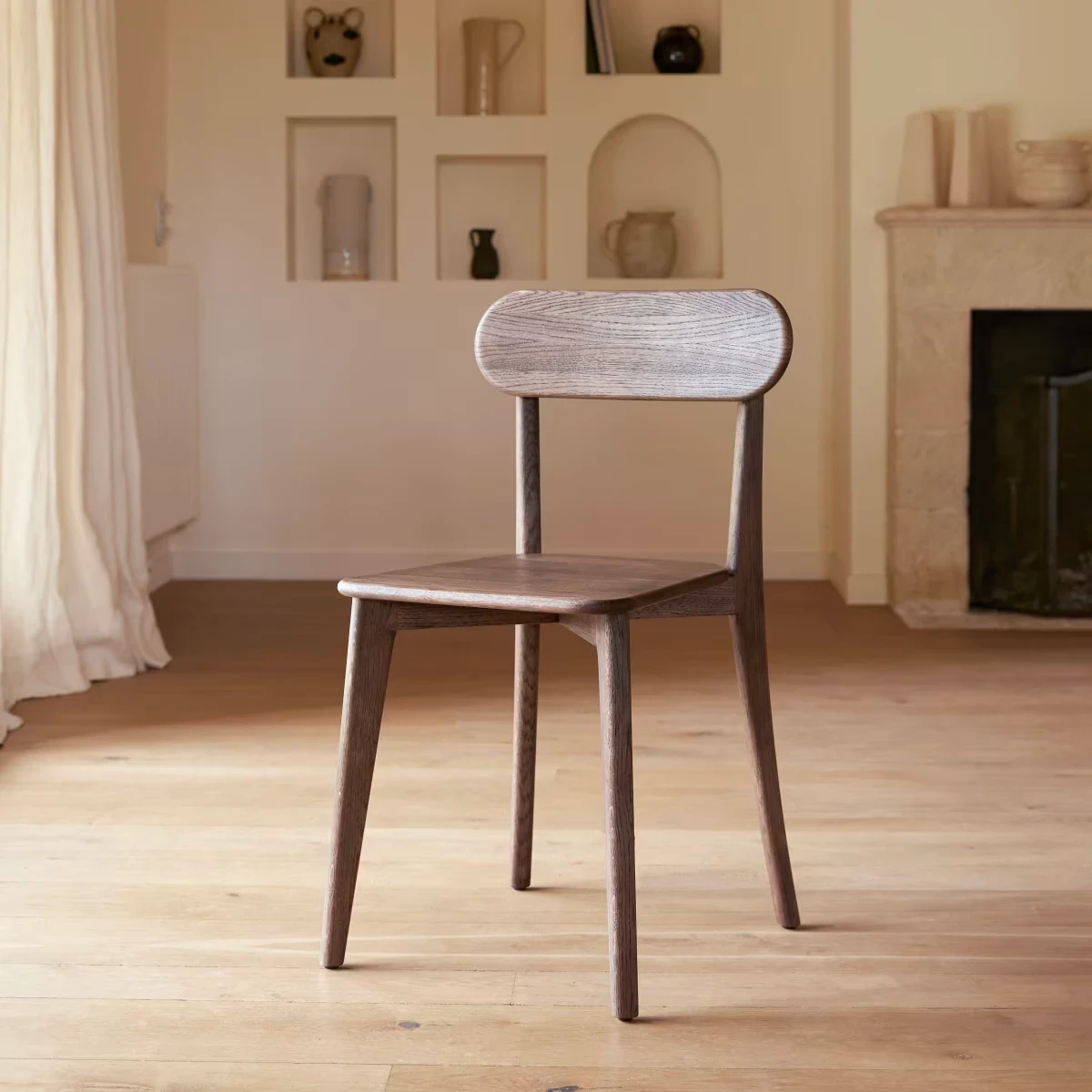
Oak and upholstery is where oak frames really shine. An oak dining chair with an upholstered seat softens the overall look and adds comfort without hiding the wood. The Tikamoon Abel chair in solid oak at £299 is a good example -- the brown leather seat balances the natural timber grain.
The 60/40 rule applies here: if oak is your dominant wood (the 60%), keep secondary woods and metals as the accent (the 40%). This prevents a room from feeling like a timber yard while still letting the oak character come through.
Which Oak Furniture to Buy First
If you are starting from scratch, invest in the piece you will use most. For most households, that is a dining table -- it takes the most daily wear, benefits most from solid construction, and sets the tone for the rest of the room. A character-grade oak dining table in the £1,300-£2,000 range from an independent UK maker is the sweet spot: well-built enough to last decades, distinctive enough to anchor a room, and priced below the point where you are paying for brand premium alone.
From there, add a sideboard or bookcase in a complementary oak tone, then layer in smaller pieces -- side tables, a desk, dining chairs -- as budget allows. You do not need to buy everything from one maker. Mixing pieces from different retailers gives a room more character than a matching set, as long as you keep the oak finish in a similar tonal family.
Browse Oak Furniture From UK Retailers
MeetFelix brings together oak furniture from boutique UK retailers in one place, so you can compare styles, prices, and materials without visiting a dozen websites. Browse all oak furniture, explore oak dining tables, or discover oak sideboards and storage.
Frequently Asked Questions
Is solid oak furniture worth the investment?
Solid oak furniture typically lasts 30 to 50 years with basic care, which makes its cost-per-year lower than cheaper alternatives that need replacing every five to ten years. A solid oak dining table bought at £1,300 and used for 30 years costs roughly £43 per year -- less than a monthly streaming subscription. The material also holds its resale value better than veneer or composite alternatives.
How can I tell if furniture is real oak or oak effect?
Check three things: weight (real oak is noticeably heavy), grain continuity (solid oak grain wraps around edges without interruption), and price (a full-size oak dining table under £300 is almost certainly not solid oak). Online, look for material specifications that explicitly state "solid oak" rather than just "oak" or "oak finish." If a listing avoids specifying the material, assume the worst.
Does oak furniture darken over time?
Yes. Oak naturally develops a deeper, warmer honey tone with exposure to light and air over the years. This is generally considered a positive characteristic -- it adds richness and depth. If you prefer to slow the darkening, keep the piece out of direct sunlight and use a clear UV-protective finish. If you want to accelerate it, regular oiling with a natural oil brings out the darker tones faster.
What is the best finish for oak furniture?
For a natural look and easy maintenance, a hard wax oil finish is the most popular choice among furniture makers. It penetrates the wood rather than sitting on the surface, so you feel the grain under your fingers. Lacquered finishes are more durable against spills but create a slightly plastic feel and are harder to repair locally if scratched. Unfinished oak is only advisable if you plan to apply your own finish immediately -- bare oak stains easily and absorbs moisture.
Can I mix oak furniture with other wood types in the same room?
Yes, and it often looks better than a full matching set. The key is contrast rather than matching: pair light oak with noticeably darker walnut or painted furniture rather than trying to find two oak tones that almost-but-do-not-quite match. Limit yourself to two or three wood tones per room for a cohesive look. Using a consistent metal finish (all black legs, or all brass hardware) across different wood pieces ties the room together.
How much does a solid oak dining table cost in the UK?
In our current collection, solid oak dining tables from boutique UK retailers start from around £1,300 for a six-seater and run to over £5,000 for a large ten-seat table. The main price drivers are size, grade (prime vs character), construction method (handmade vs factory), and whether the table extends. Mid-range options from independent makers typically sit between £1,500 and £2,500 for a table that seats six to eight.

