

Best Bookcases UK: How to Choose the Right One for Your Home
A well-chosen bookcase does more than store books. It anchors a room, displays the objects that tell your story, and solves storage problems without dominating the space. In our current collection, MeetFelix lists 48 bookcases and shelving units from boutique UK retailers like Konk, Tikamoon, Nkuku, and OKA, ranging from £49 wall-mounted teak shelves to £4,435 modular walnut storage systems. This guide covers the materials, dimensions, and styles that matter, so you can find the right piece first time.
What to Look for in a Bookcase: Materials, Construction, and Size
The single most important decision is material, because it determines how the piece looks, lasts, and fits with everything else in the room. Solid hardwoods like oak and walnut age well and hold serious weight. Engineered board is lighter and cheaper, but check the edge banding and finish quality before committing.
Solid Wood
Oak remains the most popular choice for freestanding bookcases in the UK. It takes weight without bowing, develops a warm patina over time, and works across traditional, Scandinavian, and industrial styles. American black walnut is a step up in price but delivers richer, darker tones that suit mid-century and contemporary rooms. Mango wood offers a more characterful grain at a lower price point -- across our collection, it appears in both bookcases and open shelving from brands like Tikamoon and OKA.
Teak is worth considering if you want something that handles humidity well. It is naturally moisture-resistant, which makes it a sensible choice for bathrooms or kitchens where other woods might warp.
Metal and Mixed Materials
Industrial-style bookcases typically pair solid oak or reclaimed wood shelves with raw steel or powder-coated iron frames. This combination keeps the visual weight down while maintaining structural strength. In our catalogue, Konk and Nkuku both specialise in this approach, with Konk using character grade oak and raw steel, and Nkuku favouring mango wood with hand-forged iron.
Brass-framed shelving occupies a different niche. It reads more formal, works well in living rooms and hallways, and tends to suit contemporary and traditional interiors equally. Nkuku's Mahi range, for instance, pairs antique brass metalwork with clean lines. Across our catalogue, oak is the most common bookcase material (appearing in 8 of 25 bookcases), followed by steel and iron frames, mango wood, and teak.
Size and Proportions
Before you shop, measure the wall space and decide whether you need a tall narrow unit or a low wide one. Here is a rough guide:
Room Type | Recommended Height | Recommended Width | Why |
|---|---|---|---|
Living room (main wall) | 160-220 cm | 80-150 cm | Anchors the room without overwhelming it |
Home office | 160-210 cm | 60-100 cm | Tall and narrow maximises vertical storage |
Hallway or alcove | 80-120 cm | 40-80 cm | Low profile keeps sightlines open |
Bedroom | 80-160 cm | 70-100 cm | Mid-height avoids a heavy feel |
Depth matters too. Most bookcases sit between 24-40 cm deep. Standard paperbacks need around 20 cm; larger art books and vinyl records need 30-35 cm. If you are displaying objects rather than books, shallower shelves (24-28 cm) create a cleaner look because items sit closer to the front edge.
Freestanding vs Wall-Mounted vs Modular: Which Type Works Best
Freestanding bookcases are the most versatile option and account for the majority of what is available from UK retailers. They can be repositioned when you rearrange a room, require no wall fixings, and come in the widest range of styles. The trade-off is floor space -- a typical freestanding unit is 30-40 cm deep, which adds up in smaller rooms.
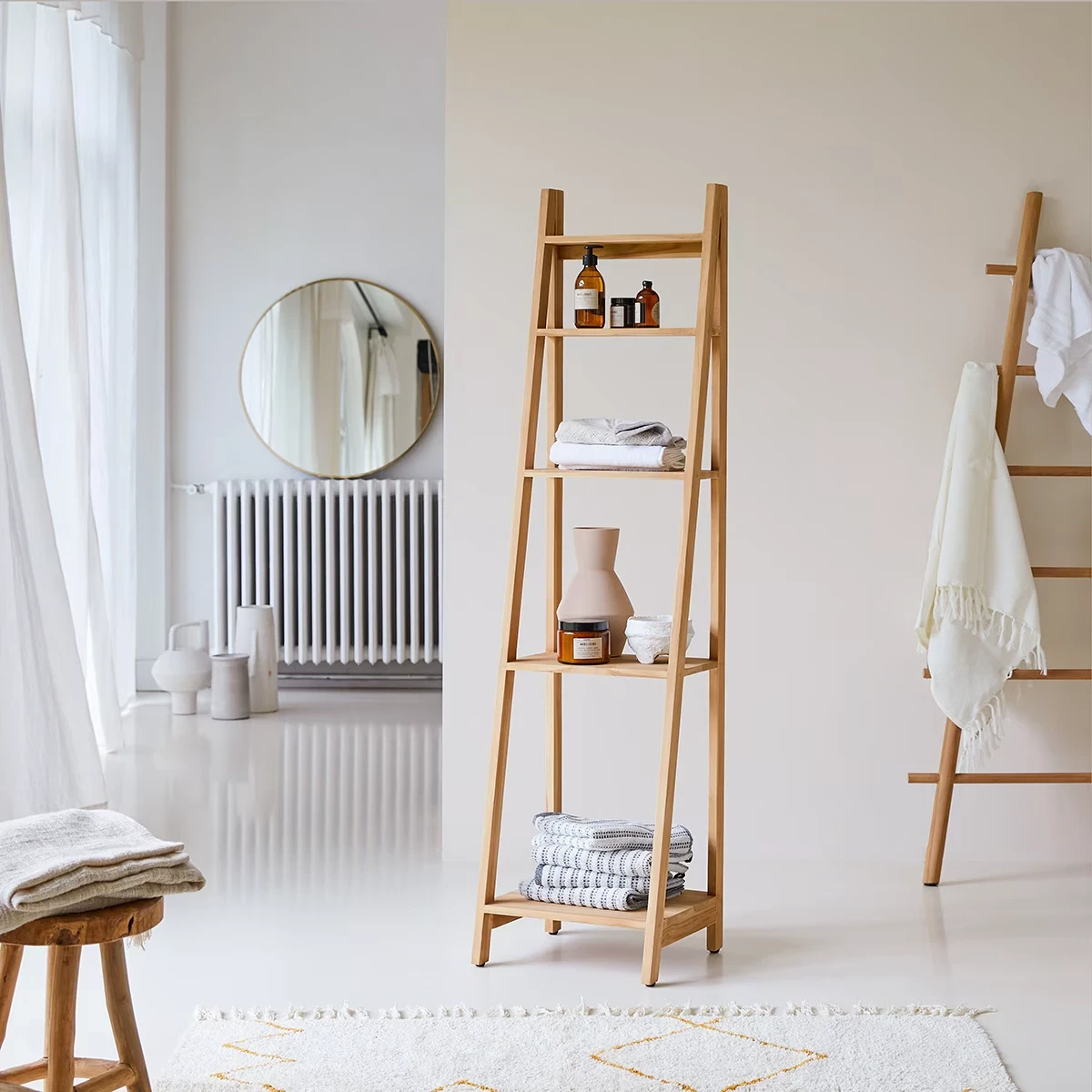
Wall-mounted shelving saves floor space entirely and creates a lighter, more open feel. It works especially well in small flats and home offices. The Tikamoon Ying Yang wall-mounted bookshelf in solid teak (£449) is a good example: it spans 100 cm wide but only projects 20 cm from the wall. The downside is that you need solid walls (not stud partition) for heavy loads, and installation is permanent.
Modular systems let you build to your exact dimensions. Tylko offers custom-configured bookcases starting from around £1,698, where you choose height, width, depth, and compartment layout online before the piece is manufactured. Konk's Wynn Modular Storage (from £4,435 in American black walnut) takes a similar approach at the premium end. Modular is the right choice if you have an awkward alcove, a very specific size requirement, or anticipate your storage needs changing over time.
!['Slim' Industrial Bookcase [Three Shelf]](https://zpeqbrudpqjbpfhmntcb.supabase.co/storage/v1/object/public/product-images/konk-furniture/konk-furniture-slimindust-mjbzftza/original/56ce8b006f5d.webp)
Best Bookcase Styles for UK Homes
The three most popular bookcase styles across UK boutique retailers are industrial (raw steel and oak), Scandinavian (clean lines, light wood), and traditional (deeper proportions, decorative details). Your choice should complement what already exists in your room -- a bookcase is a large piece of furniture, so it needs to sit comfortably alongside your sofa, dining table, or desk rather than fighting them for attention.
Industrial
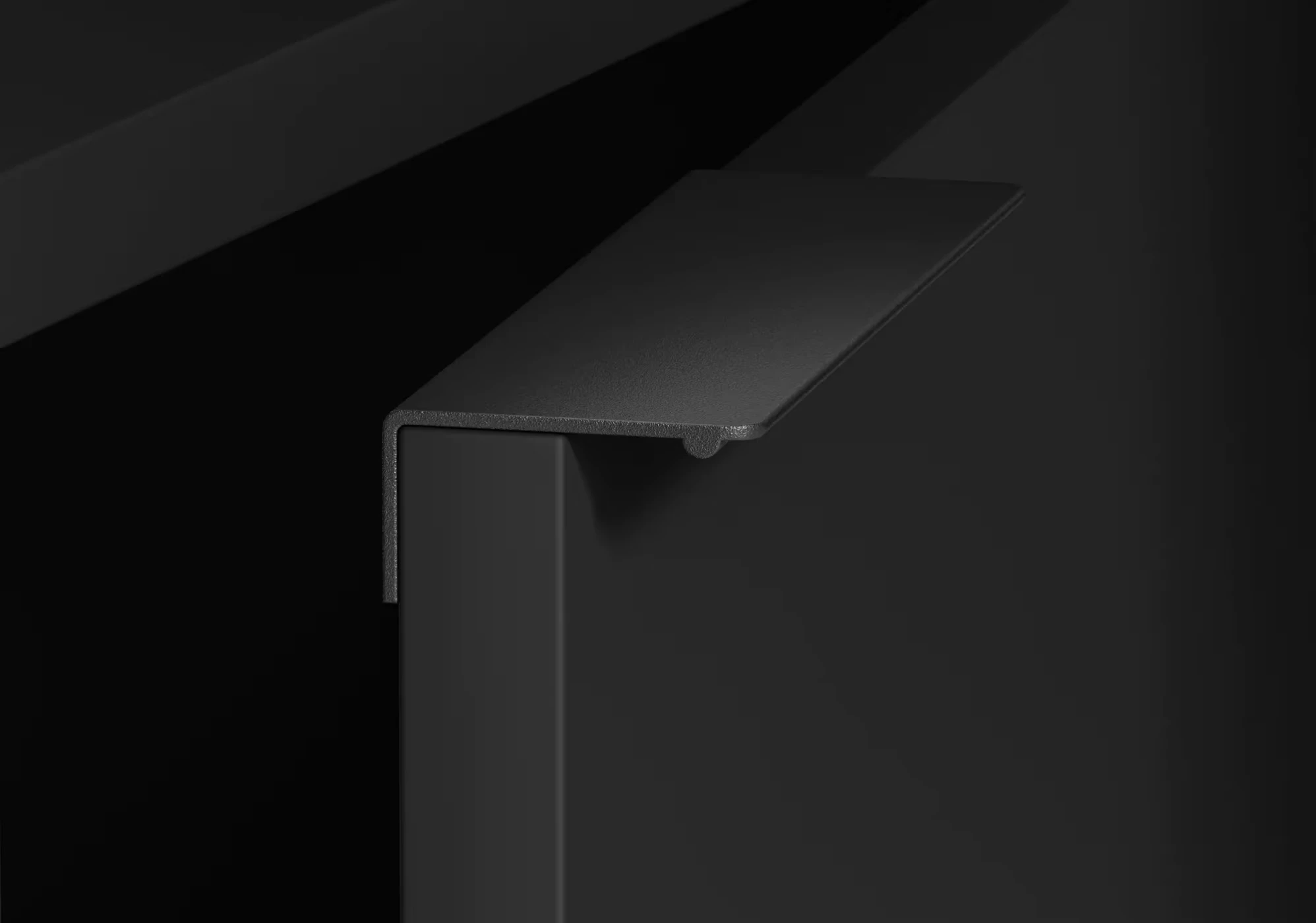
Raw steel frames paired with solid oak or reclaimed timber. The look is honest and functional -- you can see the construction, and the materials are left deliberately unfinished. Konk's industrial range is handmade in London and uses character grade English oak with welded raw steel frames. Their 'Slim' Industrial Bookcase starts at £609 for three shelves, scaling up to £989 for six shelves. Nkuku's Marjori range takes a similar approach with mango wood and hand-forged iron.
Scandinavian and Mid-Century Modern
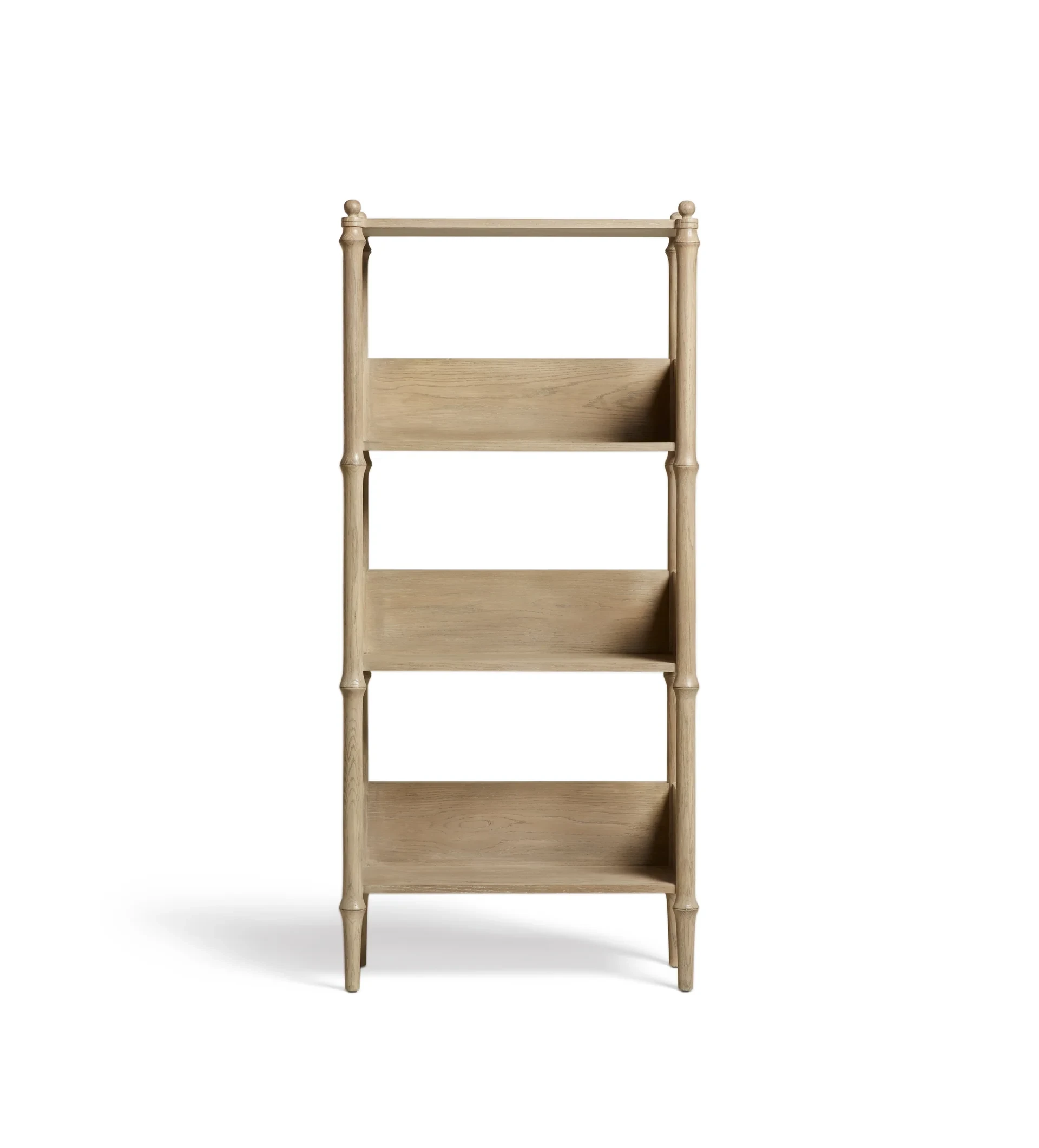
Clean lines, tapered legs, and light-toned woods like oak or ash. This style keeps rooms feeling open and uncluttered. The OKA Minshan Bookcase (£597) is a good example -- it combines oak with a simple silhouette that does not dominate the room. For a warmer, darker take, Konk's Boonk! Bookshelf in American black walnut (£1,755) has the classic mid-century combination of organic curves and rich wood tones.
Traditional and Rustic
Heavier proportions, deeper shelves, and often incorporating elements like rattan panelling, recycled elm, or decorative moulding. OKA's Castellau Bookcase (£1,495) and Elias Bookcase in Recycled Elm (£1,795) represent the upper end of this style. Tikamoon's Arko bookcase in solid mango wood (£499) offers the character-rich grain and irregular tones of rustic design at a more accessible price.
![Boonk! Bookshelf [Walnut]](https://zpeqbrudpqjbpfhmntcb.supabase.co/storage/v1/object/public/product-images/konk-furniture/konk-furniture-boonkbooks-mjbzg6wm/original/d55c40a5c56e.webp)
Price Guide: What to Expect at Each Budget Level
In our current collection, bookcase prices range from £49 for a simple wall-mounted shelf to £4,435 for a large modular system in American black walnut. The majority of freestanding bookcases from boutique UK retailers fall between £500 and £1,500. Here is what to expect at each price tier.
Price Range | What You Get | Example |
|---|---|---|
Under £300 | Wall-mounted shelves, small bathroom units, or simple open shelving in solid teak or sheesham | Tikamoon Bahya teak shelf, £199 |
£300-£700 | Mid-sized freestanding bookcases in oak, mango wood, or mixed materials. Good quality from boutique makers | OKA Minshan oak bookcase, £597; Konk Slim Industrial, £609 |
£700-£1,500 | Full-height freestanding units, industrial statement pieces, or premium open shelving in brass or reclaimed wood | Konk Classic Wooden Bookcase, £1,455; Nkuku Ibo Reclaimed Wide, £1,250 |
£1,500-£3,000 | Designer and handcrafted pieces in premium hardwoods, custom-configured modular systems | Tylko custom bookcase, £1,698; OKA Elias recycled elm, £1,795 |
Over £3,000 | Large-format modular storage in American black walnut or multi-bay systems | Konk Compartment Bookcase, £3,275; Konk Wynn Modular, £4,435 |
At time of writing, MeetFelix lists 48 bookcases and shelving units across this full range. The sweet spot for most UK living rooms is the £500-£1,000 bracket, where you get solid hardwood construction, thoughtful design, and enough size to make a visual impact without paying bespoke prices.
Open Shelving vs Closed Storage: Making the Right Call
Open shelving displays everything. That is its strength and its weakness. If you have a curated collection of books, ceramics, or art objects, open shelves let you create vignettes and change the display with the seasons. If you have a toddler, a cat, or a tendency to accumulate clutter, open shelves become a source of visual noise.
Closed storage -- bookcases with doors, drawers, or cupboard sections -- hides the mess. Several pieces in our collection combine both: Konk's 'Simple Suspension' Cupboard Bookcase (£1,319) pairs open shelves on top with a closed cupboard below, and Tikamoon's Adel in solid oak and rattan (£1,999) uses rattan-panelled doors that let air circulate while softening the visual impact.
A practical rule: if more than 60% of what you are storing is functional (files, cables, board games, school supplies), lean towards closed storage or a hybrid design. If it is mostly decorative, go fully open.
For living room storage ideas, bookcases with a mix of open and closed compartments tend to work hardest, giving you display space and hidden storage in a single footprint.
How to Style a Bookcase: Practical Advice That Works
A bookcase styled well uses roughly 60% of its shelf space and leaves 40% empty, mixing vertical and horizontal book arrangements with a few decorative objects per shelf. The difference between a bookcase that looks considered and one that looks cluttered comes down to a few simple principles.
The 60/40 rule. Fill roughly 60% of the shelf space and leave 40% empty. This prevents overcrowding and gives the eye places to rest. For more on how scale and proportion work in interior design, our guide breaks down the principle in detail.
Mix verticals and horizontals. Stand some books upright and stack others in small horizontal piles. This creates rhythm and visual interest. Use the horizontal stacks as platforms for smaller objects like vases, candles, or framed photos.
Group by colour or material. You do not need to colour-code an entire bookcase, but grouping a few books with similar spine tones creates intentional-looking clusters. The same applies to objects: group ceramics together, or cluster wooden items on one shelf.
Add one unexpected element per shelf. A small plant, a piece of art leaning against the back panel, or a textured object like a woven basket. This prevents the display from feeling like a library catalogue.
Consider the back panel. Some bookcases have solid back panels (which create a defined background), while others are open-backed (which let wall colour or texture show through). If your wall is a strong colour, an open-backed bookcase can create a framing effect. If the wall is plain, a solid back panel in a contrasting tone adds depth.
Find Your Bookcase on MeetFelix
If you are after solid wood construction and do not want to spend over £1,000, start with the mid-range options from Tikamoon and OKA -- both offer well-made bookcases in oak and mango wood with clean designs that work in most UK homes. For something with more industrial character, Konk and Nkuku's mixed-material ranges deliver genuine craftsmanship at fair prices.
MeetFelix brings together bookcases and shelving from boutique UK furniture makers, so you can compare materials, styles, and prices across retailers in one place. Browse bookcases and shelving, explore industrial shelving, or discover oak bookcases to find the right piece for your space.
Frequently Asked Questions
How much should I spend on a bookcase in the UK?
For a well-made freestanding bookcase in solid wood, expect to pay between £500 and £1,500 from boutique UK retailers. Below £300, you are typically looking at smaller wall-mounted units or simpler constructions. Above £1,500, you enter the territory of designer pieces, custom-configured modular systems, and premium hardwoods like American black walnut. At time of writing, MeetFelix lists options from £49 to £4,435.
What is the most durable wood for a bookcase?
Oak is the most widely used hardwood for bookcases in the UK because it is strong enough to bear heavy loads without sagging, takes finishes well, and ages gracefully. Teak is naturally moisture-resistant, which makes it a good choice for bathrooms or kitchens. American black walnut is softer than oak but offers a richer, darker grain that suits mid-century and contemporary interiors. Mango wood is a solid budget alternative with distinctive grain patterns, though it is not as hard-wearing as oak over decades.
Are industrial-style bookcases sturdy enough for heavy books?
Yes, provided the frame is properly constructed. The steel or iron frames used in industrial bookcases are typically stronger than wooden frames of equivalent size. The key thing to check is the shelf material and thickness. Solid oak shelves at 25-30 mm thick will hold substantial weight without bowing. Thinner engineered board shelves may sag over time under heavy loads. Konk's industrial bookcases, for example, use character grade oak on welded steel frames and are designed to handle full book loads.
How do I choose between a tall narrow bookcase and a low wide one?
Tall narrow bookcases (160-220 cm high, 60-80 cm wide) work best in rooms with higher ceilings and limited wall space, such as home offices and hallways. They draw the eye upward and make ceilings feel taller. Low wide bookcases (80-120 cm high, 100-150 cm wide) suit living rooms and bedrooms where you want storage without a dominant vertical element. They also double as a surface for table lamps, plants, or framed art.
Can I use a bookcase as a room divider?
Open-backed bookcases work well as room dividers in open-plan spaces because they provide separation without blocking light or sightlines. Look for units that are finished on all sides (not just the front), with a depth of at least 30 cm for stability. Freestanding designs with a low centre of gravity are safest. If using a tall unit as a divider, consider anchoring it to the floor or ceiling for safety, especially in homes with children.
How do I stop bookcase shelves from sagging?
Shelf sag is caused by insufficient thickness relative to span. Solid hardwood shelves (oak, walnut, teak) at 25 mm thick will span 80 cm without issues. For wider spans, look for shelves that are 30 mm or thicker, or choose designs with a centre support. Avoid placing the heaviest items in the middle of a long shelf -- distribute weight towards the supports at each end. If you already have sagging, flipping the shelf upside down and redistributing weight can sometimes correct minor bowing over time.

