

Best Chest of Drawers UK: How to Choose the Right One for Your Bedroom
A chest of drawers does two jobs at once: it stores everything from jumpers to jewellery, and it sets the visual tone for the most private room in your home. Get it wrong and you end up wrestling with sticky runners every morning or staring at a piece that clashes with everything around it. In our current collection, MeetFelix brings together chest of drawers from boutique UK makers including Konk, Nkuku, and OKA -- in solid oak, walnut, mango wood, acacia, and reclaimed timber, priced from £800 to over £5,000. This guide covers what actually matters when choosing bedroom drawers: the materials that hold up to daily use, the construction details that separate a ten-year piece from a twenty-year one, and the sizes that work in real UK bedrooms.
How to Choose the Right Size for Your Bedroom
The most common mistake with a chest of drawers is buying one that overwhelms the wall it sits against or leaves awkward gaps either side. Measure the wall space first, then work backwards -- leaving at least 10cm clearance on each side and 5cm behind for skirting boards and airflow.
Standard Dimensions to Know
UK chest of drawers broadly fall into three size categories:
Type | Typical Width | Typical Height | Best For |
|---|---|---|---|
Narrow / Tallboy | 40-60cm | 100-130cm | Small bedrooms, alcoves, beside wardrobes |
Standard | 70-90cm | 80-110cm | Most UK double bedrooms (10-14 sqm) |
Wide / Low | 100-140cm | 70-85cm | Larger rooms, under windows, doubling as a vanity surface |
A tallboy works well in a bedroom where floor space is tight but ceiling height is generous -- typical of Victorian and Edwardian terraces. A wide, low chest suits rooms where the wall opposite the bed needs visual weight without height.
For most UK double bedrooms (around 12 square metres), a standard chest between 80-100cm wide and 90-100cm tall hits the right balance. It holds enough clothing for one person comfortably, or basics for two if paired with a wardrobe.
Drawer Count and Depth
More drawers does not always mean more storage. Five shallow drawers hold roughly the same volume as three deep ones, but shallow drawers keep contents more visible and accessible.
A useful rule: deep drawers (20cm+) for bulky items like knitwear and towels, shallow drawers (12-15cm) for underwear, accessories, and folded t-shirts. The best chests mix both -- two or three deep drawers below, one or two shallow drawers on top.
Solid Wood vs Engineered: What Actually Lasts
The material your chest of drawers is built from determines how it looks in ten years, not just on delivery day. Solid hardwood ages well, developing a richer patina over time. Engineered boards (MDF, particleboard) can work at lower price points but respond poorly to moisture and move-related knocks.
The Best Hardwoods for Bedroom Drawers
In our current collection, the most common materials are oak, American black walnut, mango wood, and acacia. Each has distinct characteristics:
Material | Grain Character | Durability | Price Range | Best For |
|---|---|---|---|---|
Oak | Prominent, warm | Very high -- dense and scratch-resistant | £1,000-£5,000+ | Investment pieces, families with children |
American Black Walnut | Rich, dark, flowing | High -- naturally hard, deepens with age | £1,000-£2,600 | Statement bedrooms, mid-century schemes |
Mango Wood | Varied, characterful | Good -- medium hardness, needs sealing | £800-£1,250 | Bohemian or natural interiors, budget-conscious buyers |
Reclaimed Wood | Unique, weathered | Variable -- depends on source timber | £850-£1,500 | Rustic and eclectic bedrooms |
Acacia | Distinctive, interlocking | Good -- naturally water-resistant | £800-£1,000 | Entry-level solid wood, warm-toned rooms |
Oak is the workhorse: dense, scratch-resistant, and predictable across decades. Walnut is the showpiece, with a depth of colour that makes a bedroom feel considered and warm. Mango wood sits in between -- characterful grain at a more accessible price, though it needs a good finish to protect against moisture. Browse solid wood chest of drawers on MeetFelix to see how grain patterns vary across pieces.
Construction Details That Matter
Beyond the timber itself, look for these signs of quality:
Dovetail joints on drawer boxes -- interlocking cuts that hold without glue loosening over years
Solid wood drawer bases rather than thin hardboard that bows under weight
Full-extension runners that let you reach the back of every drawer without fumbling
Birch plywood backs and drawer bottoms -- a hallmark of workshop-made furniture, far more stable than MDF
Several makers in our collection, including Konk, use birch plywood for structural elements alongside solid hardwood fronts and sides. This is good engineering, not a compromise -- birch ply is dimensionally stable and resists warping in centrally heated bedrooms.
Style Guide: Matching Drawers to Your Bedroom
A chest of drawers sits at eye level from the bed, which means it anchors the room's visual tone more than most furniture. The style needs to work with your bed frame, bedside tables, and the room's overall character.
Contemporary and Mid-Century
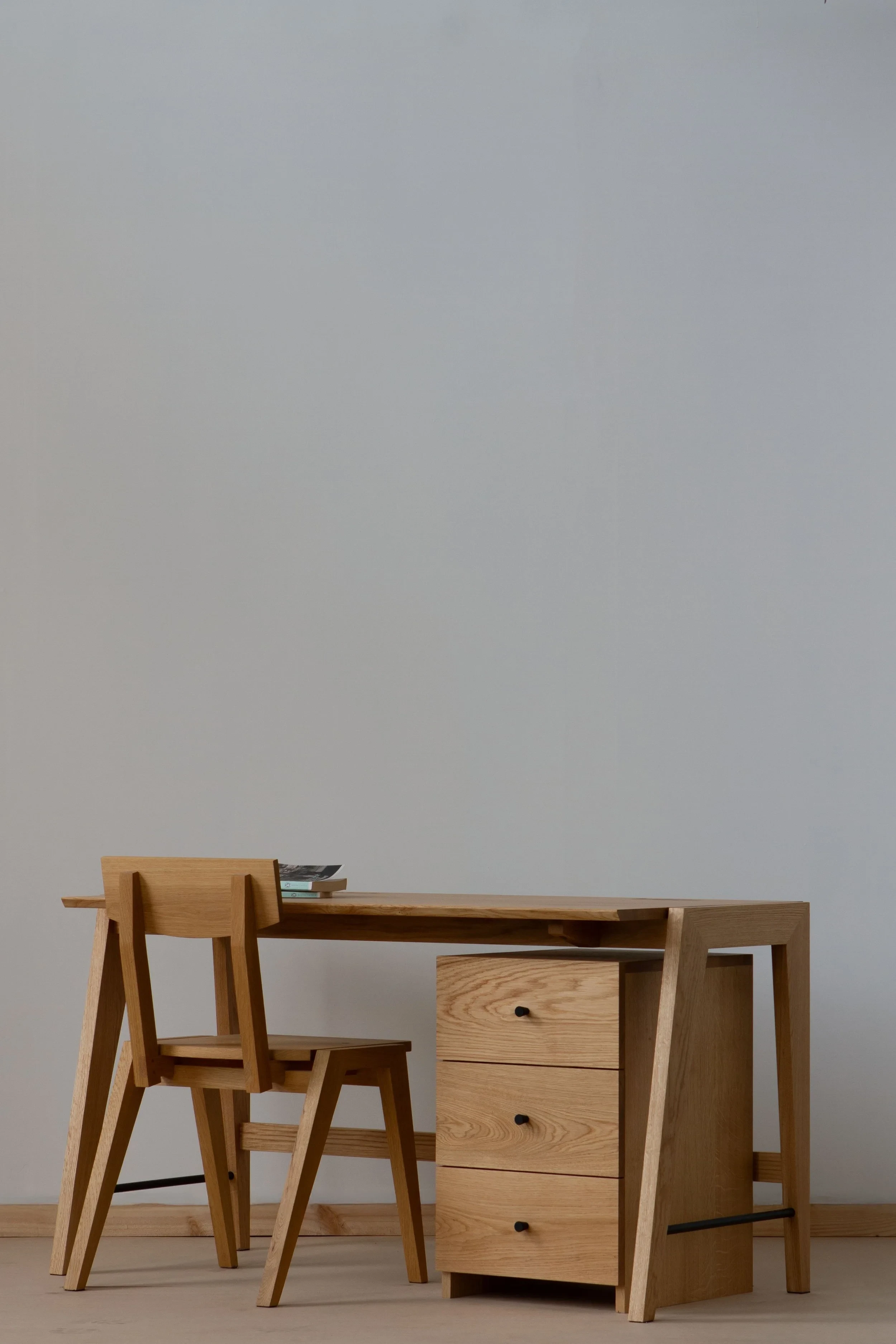
Clean lines, tapered legs, and visible wood grain define this territory. Look for pieces where the timber does the talking -- minimal hardware, flush or recessed handles, and legs that lift the piece off the floor. Walnut is the natural choice here, and mid-century chests account for roughly a third of the styles in our current catalogue.
The Konk Mut Drawers are a good example: mixed oak and walnut with birch ply construction, hitting the mid-century mark without pastiche.
Industrial and Rustic
Raw steel frames paired with solid timber bring texture and weight to a bedroom. Industrial chests tend to be heavier and more compact -- the metal framework adds structural rigidity but also kilograms. They work well in rooms with exposed brick, concrete floors, or darker colour palettes.
![Industrial Drawers [Two Drawer]](https://zpeqbrudpqjbpfhmntcb.supabase.co/storage/v1/object/public/product-images/konk-furniture/konk-furniture-industrial-mjc2e0ri/original/b2ec2fa4427a.webp)
Natural and Bohemian
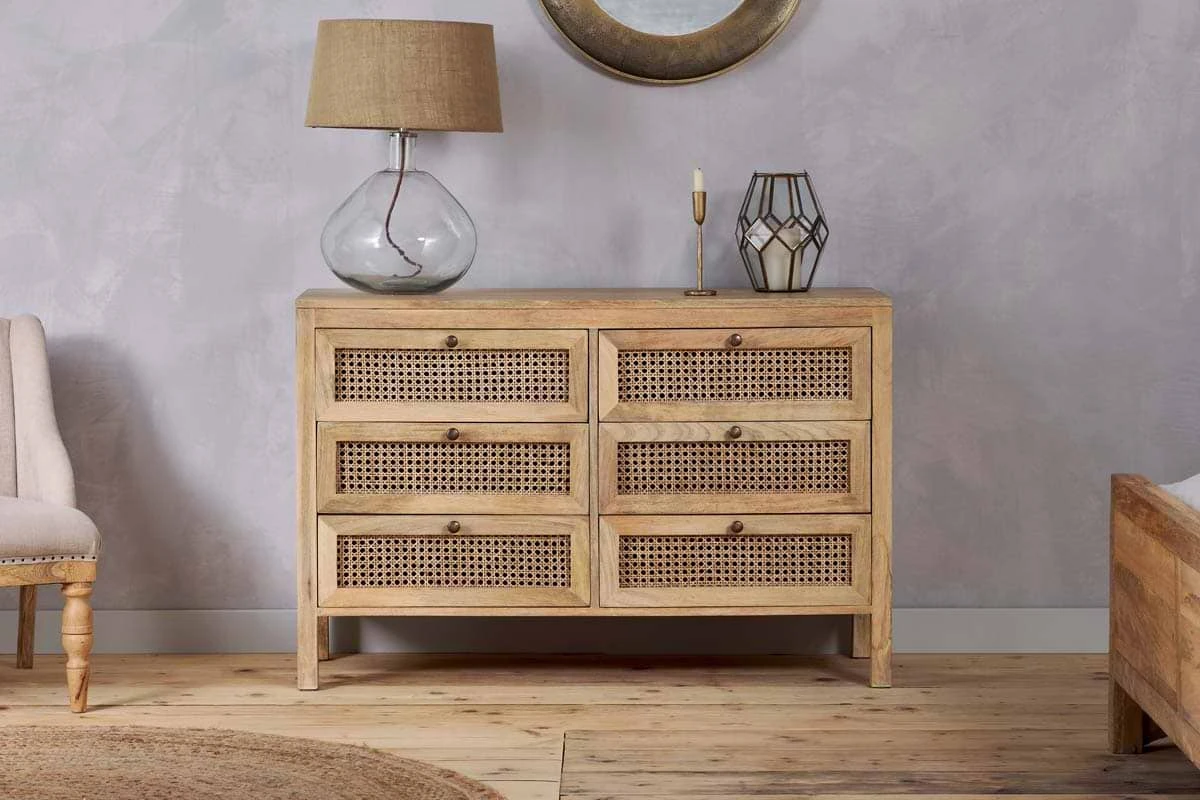
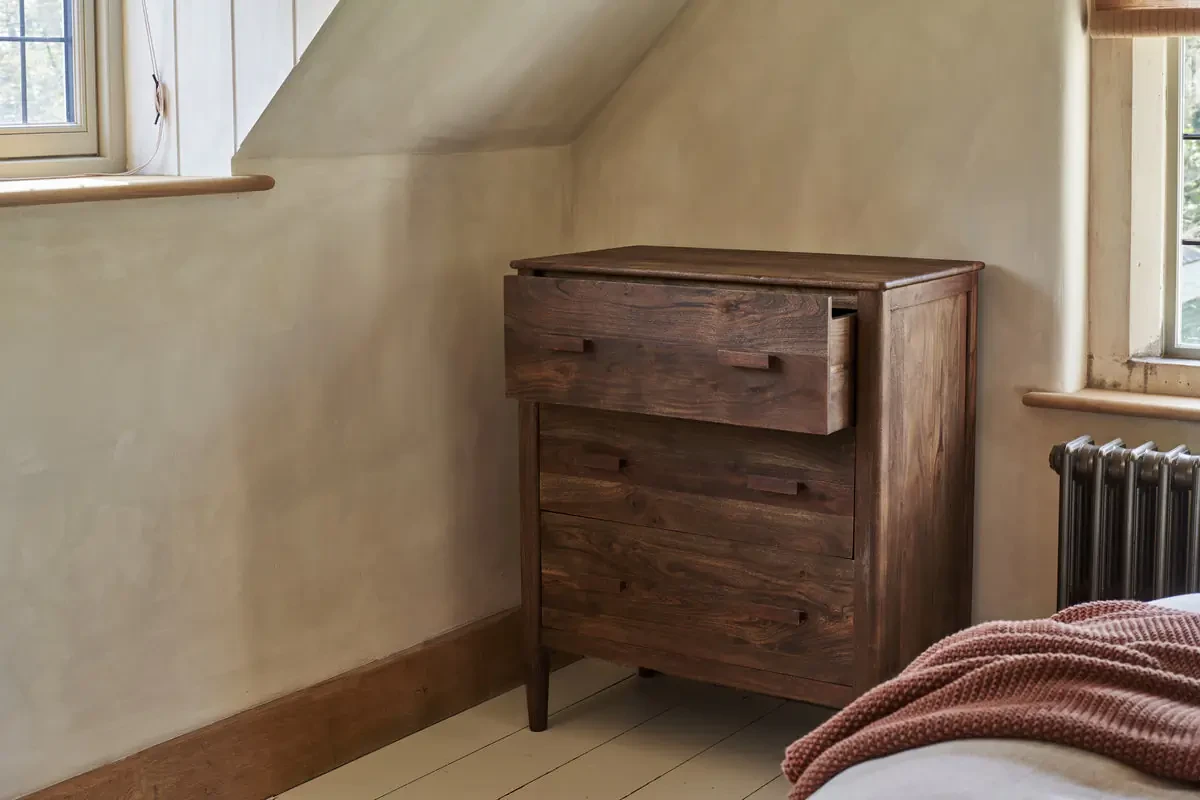
Mango wood, cane panelling, and reclaimed timber create warmth without formality. These pieces tend to have more surface variation -- natural knots, colour shifts, visible joinery -- which reads as intentional rather than imperfect. The Nkuku range leans heavily into this territory, with mango wood and iron combinations that pair well with linen bedding and woven textiles.
What to Spend: A Realistic Price Guide
At time of writing, chest of drawers from boutique UK makers start at around £800 for solid acacia and rise past £5,000 for bespoke oak pieces. That range is wide, so here is where the price breaks fall and what you gain at each tier.
Under £1,000: Solid Wood Entry Point
At this level you can find well-made pieces in mango wood and acacia from Nkuku, with handcrafted details like cane panelling and iron accents. Expect three to five drawers, straightforward construction, and timbers that respond well to a wax or oil finish. The Nkuku Anbu Acacia at £800 is a strong entry point -- solid construction in a warm walnut-wash finish.
£1,000-£1,800: The Sweet Spot
This is where oak and walnut options open up, along with more refined construction. Konk's workshop-made pieces sit here, with birch ply internals, dovetail-inspired joinery, and the kind of material selection (prime grade oak, character grade) that means every piece has its own personality. If you can stretch to this range, the difference in drawer action and material quality over the sub-£1,000 tier is noticeable.
£1,800-£3,000: Statement and Investment
At this tier, expect American black walnut throughout, custom steel detailing, and the kind of surface finish that improves with handling. Pieces like the Konk Boonk! (£2,259) and Yuki Drawers (£2,125) are built to last decades and hold their visual appeal throughout.
![Boonk! Chest of Drawers [Walnut]](https://zpeqbrudpqjbpfhmntcb.supabase.co/storage/v1/object/public/product-images/konk-furniture/konk-furniture-boonkchest-mjc2q9c1/original/dc91badfa569.webp)
Over £3,000: Bespoke and Heirloom
The top end of our collection includes one-off and limited-run pieces where every detail -- from the timber sourcing to the finish -- is specified. The Konk Skulpt Drawer Chest at £5,175 represents this tier: solid oak, architectural proportions, and the kind of craftsmanship that ages into something your children will want to keep.
Care and Maintenance: Making Drawers Last
Solid wood furniture in a bedroom faces two main threats: fluctuating humidity from central heating, and surface damage from daily contact. A few simple habits extend the life of any chest of drawers significantly.
Humidity control matters most. Central heating dries indoor air to 20-30% relative humidity in winter, which causes solid wood to shrink and potentially crack. A small hygrometer (under £10) and a room humidifier during heating season keep things in the 40-55% range where wood stays stable.
Surface protection depends on the finish. Oiled wood (common on mango and reclaimed timber) needs re-oiling once or twice a year with a furniture-specific product -- Danish oil or hard wax oil work well. Lacquered pieces (more common on oak and walnut) need less maintenance but should be wiped with a damp cloth, never wet, and dried immediately.
Drawer runners benefit from an annual application of furniture wax or a candle rubbed along the runner tracks. This prevents the wood-on-wood sticking that makes older chests frustrating to use.
Avoid placing a chest of drawers directly against a radiator or in direct sunlight, both of which accelerate wood movement and colour fading.
Find Your Chest of Drawers
MeetFelix brings together bedroom furniture from boutique UK makers so you can compare options side by side. Browse all chest of drawers, explore oak bedroom furniture, or discover walnut chest of drawers from independent workshops.
Frequently Asked Questions
What is the best wood for a chest of drawers?
Oak is the most durable and versatile choice for a chest of drawers that needs to last decades. Its density resists scratches and dents from daily use, and it takes both oiled and lacquered finishes well. American black walnut is the premium alternative -- softer than oak but with a richer colour and grain that suits contemporary and mid-century bedrooms. For a more characterful look at a lower price, mango wood offers distinctive grain variation and performs well when properly sealed.
How many drawers do I need in a chest of drawers?
For a single person's bedroom, a five-drawer chest (two shallow, three deep) typically holds enough essentials -- underwear and accessories in the top drawers, knitwear and folded clothing below. Couples sharing a chest should look for a six-drawer or wide model, or pair a standard chest with a separate bedside table that has its own drawer. Count your folded items first: most people underestimate how much space knitwear and loungewear actually need.
Should a chest of drawers match the bed frame?
Not necessarily, and often a deliberate contrast works better than a forced match. What matters is a shared design language -- similar proportions, compatible wood tones, or a consistent hardware finish (all brass, all matte black). A walnut chest against an oak bed frame can look considered if the leg styles or silhouettes echo each other. Exact timber matching across different makers is nearly impossible and usually looks like you tried too hard.
How do I stop my wooden drawers from sticking?
Sticking drawers are usually caused by humidity changes making the wood swell, or by worn runners. First, check that the chest is level -- uneven weight distribution causes drawers to bind. If the wood has swollen, wait for drier conditions or use a dehumidifier; do not sand or plane drawers when they are swollen, as they will become too loose when humidity drops. For persistent sticking, rub a candle or block of beeswax along the runner tracks and the drawer base edges. Replace worn runners if the wood is grooved or splintered.
Is a tallboy or a wide chest better for a small bedroom?
In bedrooms under 10 square metres, a tallboy (40-60cm wide, 100-130cm tall) almost always makes more sense. It stores the same volume as a wide chest while freeing floor space for circulation. The trade-off is that top drawers sit above shoulder height, making them harder to access daily -- use those for seasonal items. Fix tallboys to the wall with an anti-tip bracket, which is both a safety requirement and structurally sensible.
How should I organise my chest of drawers?
Place items you reach for every day -- underwear, socks, everyday tops -- in the top two drawers where they are easiest to see and grab. Middle drawers suit folded trousers, casual knitwear, and loungewear. Bottom drawers work for bulky or seasonal items you access less often. Drawer dividers (fabric or wood) prevent small items from migrating into a jumbled mass. The KonMari vertical folding method genuinely helps in shallow drawers -- standing items upright lets you see everything at a glance rather than digging through layers.

