

Best Dining Tables UK: How to Choose the Right One for Your Home
A dining table is the one piece of furniture that earns its keep every single day. It hosts weeknight dinners, Sunday roasts, homework sessions, birthday candles, and those conversations that stretch long past dessert. Get it wrong and you notice every time you sit down — too cramped, too wobbly, wrong height, wrong material for your life. In our current collection, we compared over 120 dining tables from 6 UK boutique retailers, priced from £349 to £5,295, in solid oak, walnut, mango wood, acacia, and reclaimed teak. This guide covers what actually matters: shape, size, material, and how to match a table to the way you really live.
How to Choose the Right Dining Table Shape
For most UK homes, a rectangular table seats the most people in the least space — a 180cm rectangular table fits six comfortably and slides against a wall when not in use. Round tables work better in square rooms and kitchens under 12 square metres, where corners create dead space.
Each shape has trade-offs worth understanding before you commit.
Rectangular tables are the default for a reason. They fit neatly against walls, scale well from four to twelve seats, and suit the proportions of most UK dining rooms. They also pair naturally with benches on one side, which saves space and seats more people. The downside: corners can feel formal, and conversation across the table gets difficult once you go beyond 200cm.
Round tables encourage conversation because everyone faces the centre. They work well in open-plan spaces where you want the table to feel less dominant. In our current collection, we found over 10 round dining tables from UK retailers starting at £349. The practical limit is about 150cm diameter — beyond that, reaching the centre becomes awkward.
Oval tables split the difference. They seat as many as a rectangular table but soften the room with curved edges. Worth considering if you have children or a tight walkway beside the table.
Shape | Best For | Seats Comfortably | Minimum Room Width |
|---|---|---|---|
Rectangular (180cm) | Most UK dining rooms | 6 | 270cm |
Round (120cm) | Square rooms, small kitchens | 4-5 | 270cm |
Oval (180cm) | Open-plan spaces, families | 6-8 | 270cm |
Square (90cm) | Breakfast nooks, couples | 2-4 | 230cm |
What Size Dining Table Do You Actually Need?
Allow 60cm of table width per person as a minimum — 70cm is more comfortable, especially if you entertain regularly. For depth, 90cm is the standard for a rectangular table, giving enough room for plates, glasses, and serving dishes without feeling cramped.
Here is a straightforward sizing guide based on seating capacity:
Seats | Rectangular (L x W) | Round (Diameter) |
|---|---|---|
4 | 120 x 80cm | 100-110cm |
6 | 160-180 x 90cm | 130-140cm |
8 | 200-220 x 90cm | 150cm |
10 | 240-260 x 100cm | Not recommended |
12 | 280-300 x 100cm | Not recommended |
Room clearance matters as much as table size. Leave at least 90cm between the table edge and the nearest wall or furniture — 100cm if chairs need to push back without hitting anything. For walkways behind seated diners, 60cm is the absolute minimum.
A common mistake is buying a table that fills the room when empty but becomes impassable with chairs pulled out. Measure with the chairs in their dining position, not tucked under the table.
Extendable Tables: When They Make Sense
If your household is two to four people but you host larger gatherings monthly, an extendable table is a practical compromise. In our current collection, we found extendable dining tables starting from £899, with most extending by 40-60cm — enough for two extra place settings.
Look for butterfly-leaf mechanisms over drop-leaf designs. Butterfly leaves store inside the table and deploy in seconds. Drop leaves require separate storage and tend to wobble at the join.
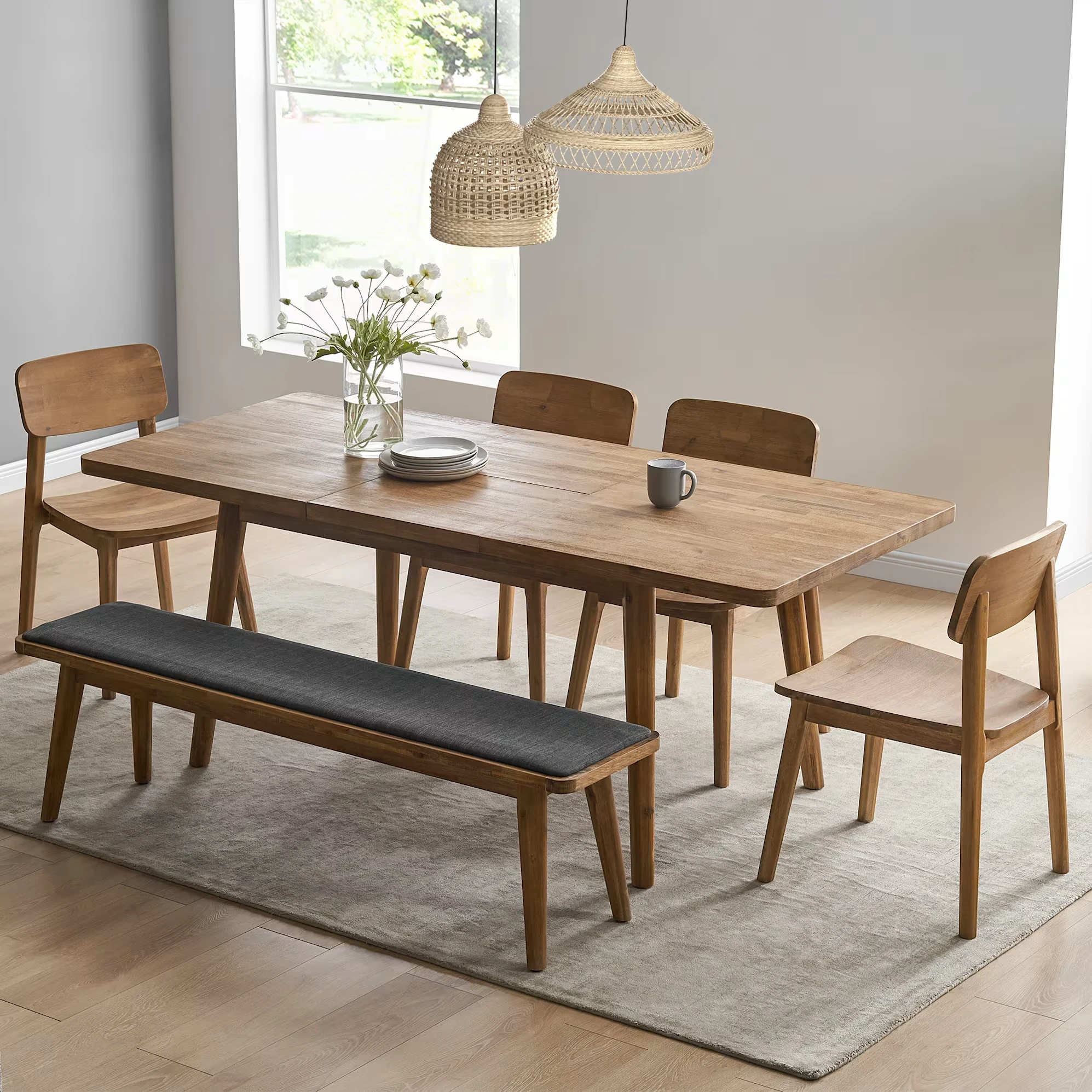
The Castlery Seb Extendable is a good example of the format done well — solid acacia wood with a mid-century silhouette that extends from 150cm to 200cm, seating four to six without compromising on stability.
Dining Table Materials: What Holds Up and What Does Not
Solid hardwood — oak, walnut, acacia, or teak — is the most reliable material for a dining table that will see daily use. In our current collection, oak and walnut together account for roughly 60% of all dining tables, and for good reason: they handle heat, moisture, and wear better than engineered alternatives and can be sanded back and refinished when scratched.
Solid hardwood (oak, walnut, teak, acacia) remains the most reliable choice for a dining table that will see daily use. It develops character over time rather than deteriorating. Oak is the most popular material in our collection — across our catalogue, oak appears in nearly 40% of dining tables, followed by walnut at around 20%. Solid oak tables from UK makers start at around £1,000 and go up from there, but the price reflects longevity. A well-made oak table lasts decades.
Walnut is warmer in tone than oak, with richer grain patterns. American black walnut is the standard in boutique furniture — darker and more consistent than European walnut. It costs more than oak but creates a distinctly different atmosphere. Worth the premium if your room leans contemporary or mid-century.
Mango wood has gained ground as a sustainable alternative. It is harvested from trees that no longer produce fruit, which gives it genuine eco credentials. The grain tends to be lighter and more varied than oak. Nkuku's Anbu range is a good entry point for mango wood dining tables.
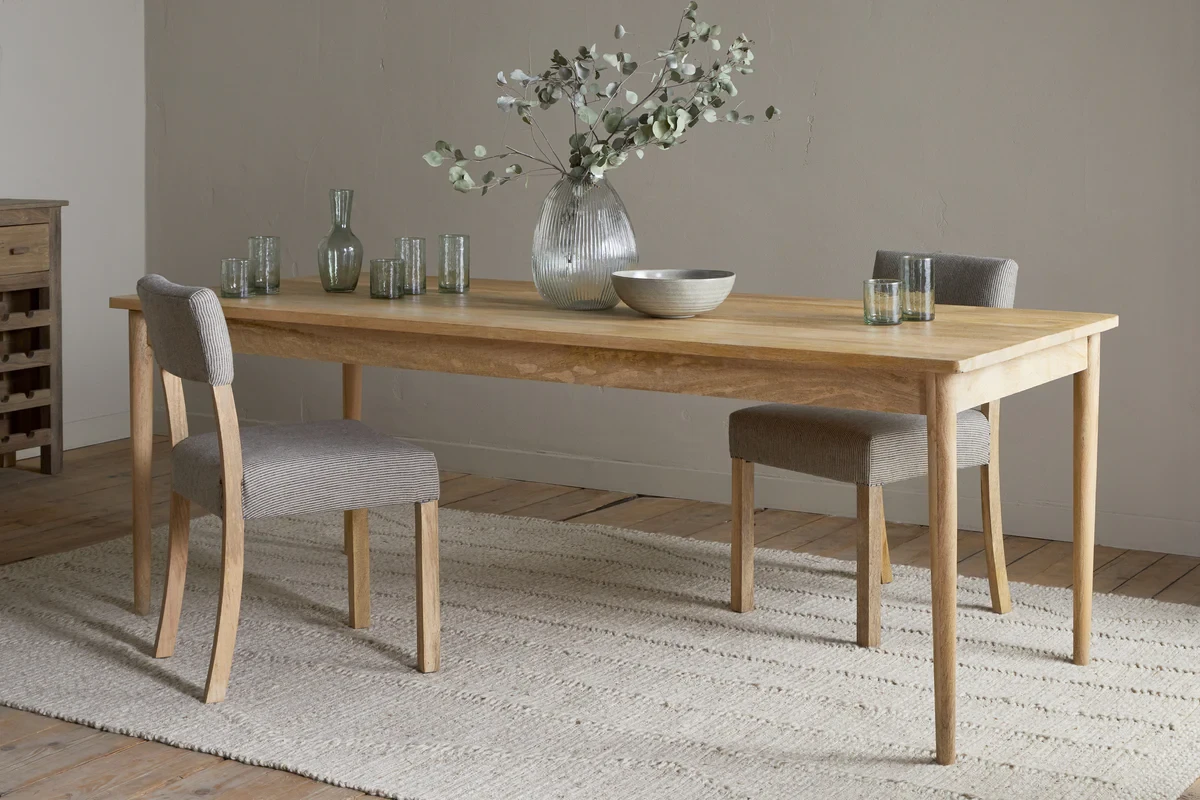
Reclaimed teak brings texture and history that new wood cannot replicate. Each piece shows its past life — nail holes, weathering, and colour variation. It is exceptionally hard-wearing but suits a specific aesthetic.
Engineered wood with veneer offers a price advantage and better dimensional stability (it will not warp with humidity changes). The trade-off is that you cannot sand and refinish it. For a table you plan to keep for five to ten years rather than a lifetime, this is a reasonable compromise.
Material | Price Range (UK) | Durability | Maintenance | Best For |
|---|---|---|---|---|
Solid oak | £995-£5,295 | Excellent | Oil annually | Long-term investment |
American black walnut | £1,100-£3,500 | Excellent | Oil or wax twice yearly | Contemporary interiors |
Mango wood | £950-£1,250 | Good | Oil or wax annually | Sustainable choice |
Reclaimed teak | £995-£1,500 | Excellent | Minimal — ages naturally | Rustic, industrial schemes |
Acacia | £549-£999 | Good | Oil annually | Mid-range budgets |
Engineered + veneer | £599-£899 | Moderate | Wipe clean, avoid water | Budget-conscious buyers |
The Best Dining Tables at Every Budget
Across our collection of 120+ dining tables from 6 UK boutique retailers, the price range runs from £349 to £5,295. Here is where the value sits at each level.
Under £700: Solid Starters
At this price point, you are choosing between solid hardwood from newer brands and engineered wood with veneer from more established names. Castlery dominates this range with well-designed mid-century options.
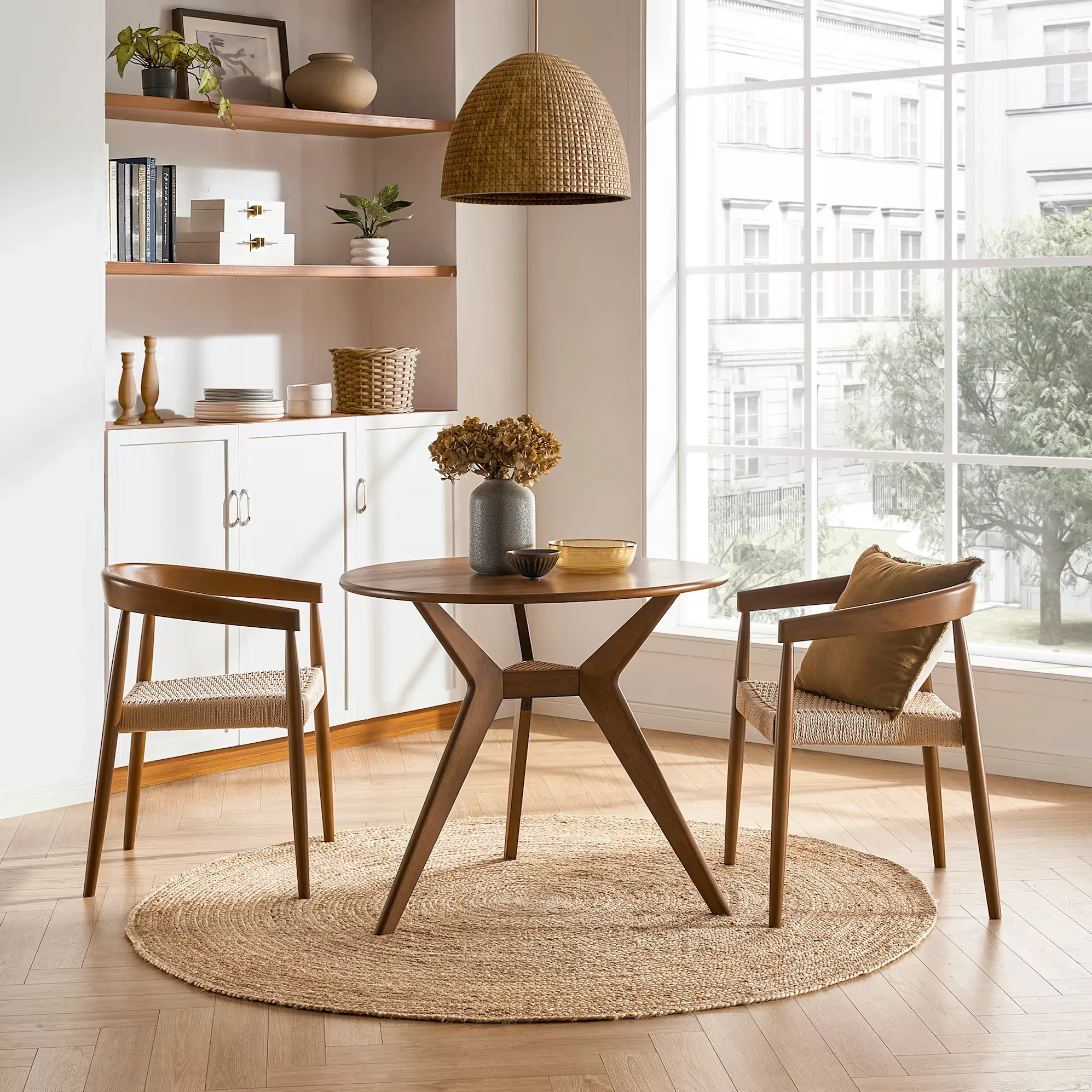
The Tribeca Round from Castlery at £349 is the most accessible solid wood dining table in our collection — rubberwood with walnut veneer, 100cm diameter, seating four comfortably. It suits small kitchens and open-plan flats where space is tight.
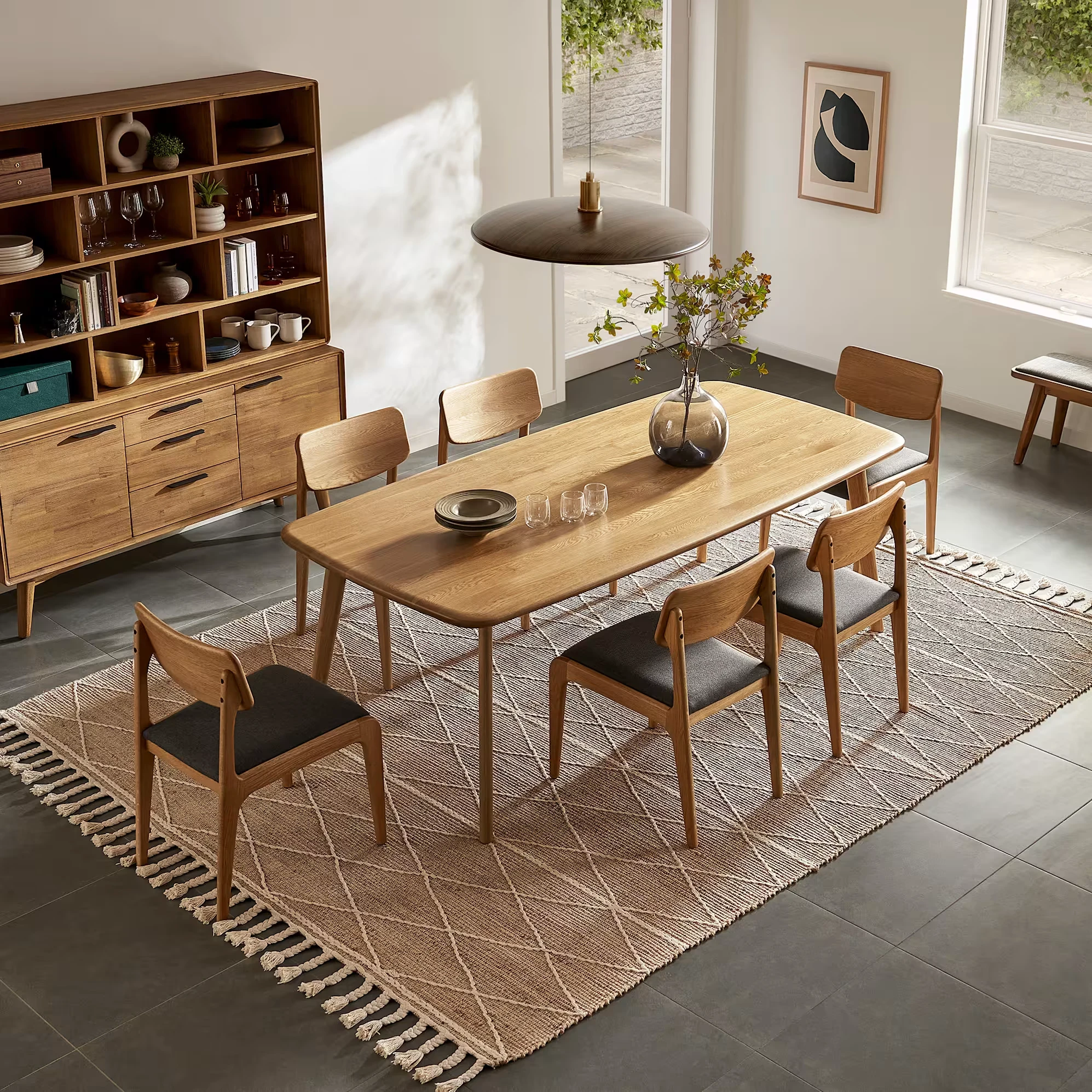
For a rectangular table at this price, the Vincent Dining Table in oak from Castlery at £599 is a strong choice — solid oak with clean Scandinavian lines and enough surface for six.
£700-£1,500: The Sweet Spot
This is where the widest choice sits. You can afford solid hardwood from independent makers, interesting materials like mango wood and reclaimed teak, and extendable options that do not feel like an afterthought.
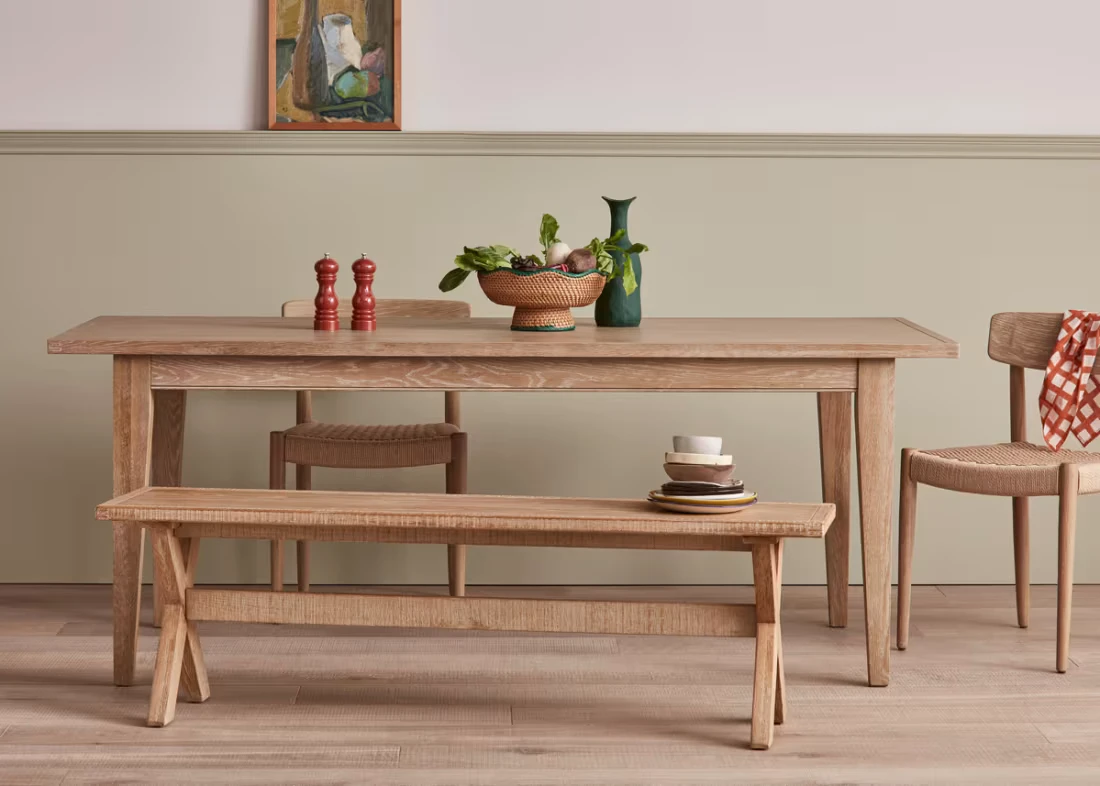
The Loaf Bread Table in whitewashed oak at £995 captures a farmhouse warmth that is hard to find elsewhere — chunky proportions, hand-finished surfaces, and enough personality to anchor a room without overpowering it.
£1,500 and Above: Heirloom Quality
At this level, you are buying from specialist makers who control the entire production process. Konk Furniture, based in the UK, handmakes every table from character-grade oak and American black walnut. Their 'A Frame' Table starts at £1,355 and combines industrial steel legs with a thick hardwood top that shows the natural grain.
!['A Frame' Table [Metal Legs]](https://zpeqbrudpqjbpfhmntcb.supabase.co/storage/v1/object/public/product-images/konk-furniture/konk-furniture-aframetabl-mjbzmkf3/original/e1cff98cdc9f.webp)
At the top of the range, OKA's Allegro Rectangular in oak at £5,295 is an investment-grade table designed for larger dining rooms — traditional construction, burnished finish, and the kind of presence that makes a room.
How to Match a Dining Table to Your Interior Style
The dining table sets the design direction for the entire room. Get this choice right and everything else — chairs, lighting, tableware — falls into place around it.
Contemporary and mid-century: Clean lines, tapered legs, minimal ornamentation. Oak, walnut, and ash in natural finishes. Across our catalogue, mid-century modern is the most common style tag on dining tables, appearing on over 55 products. Look for slim profiles and visible wood grain.
Rustic and farmhouse: Chunky proportions, turned legs, distressed or whitewashed finishes. Oak, reclaimed teak, and mango wood. The emphasis is on texture and imperfection — surfaces that look better with use rather than worse.
Industrial: Metal legs (typically raw steel or powder-coated black) paired with thick hardwood tops. Konk Furniture specialises in this combination with character-grade oak and raw steel. The contrast between refined wood and utilitarian metal creates visual tension.
Scandinavian: Light-toned woods (ash, pale oak, birch), simple forms, and an emphasis on proportion over decoration. Browse Scandinavian dining tables to see how this translates across different sizes and price points.
Mixing Chairs with Your Table
You do not need to buy a matching dining set. In fact, mixing chair styles with your table often creates a more considered room. Two principles to follow:
Match height, not style. Seat height should be 28-30cm below the table top. Standard dining tables are 75cm tall, so look for chairs with a 45-47cm seat height.
Contrast material or form. A solid oak table works well with upholstered chairs for warmth, or with metal-framed chairs for an industrial edge. Already have your eye on something? Browse dining chairs to find the right pairing.
Caring for Your Dining Table
Solid wood tables are lower maintenance than most people expect, but they do need occasional attention to stay looking their best.
Oiled finishes (common on oak and walnut) need re-oiling once or twice a year. Use a food-safe hardwax oil — Osmo and Rubio Monocoat are the most recommended by UK furniture makers. Apply a thin coat, let it soak in for twenty minutes, then buff off the excess. The whole process takes under an hour.
Lacquered finishes need only wiping with a damp cloth. They resist stains better than oil but cannot be spot-repaired if scratched.
Heat and moisture are the main enemies. Always use trivets under hot dishes and coasters under cold glasses. Water rings on oiled wood can usually be removed with a light sanding and re-oil. On lacquered surfaces, they are permanent.
Daily care: Wipe with a slightly damp cloth and dry immediately. Avoid silicone-based sprays — they build up over time and make re-finishing difficult.
Browse Dining Tables on MeetFelix
If you are buying one table for the next decade, start with solid oak or walnut in the £700-£1,500 range — that is where quality, choice, and value overlap most. For everyday family use, acacia and mango wood in the £500-£1,000 range offer genuine durability without the premium price.
MeetFelix brings together dining tables from boutique UK retailers — so you can compare options from Konk, Castlery, Nkuku, OKA, and Loaf side by side. Browse oak dining tables, explore round dining tables, find extendable dining tables, or see all dining tables to start comparing.
Frequently Asked Questions
What is the best wood for a dining table in the UK?
Oak is the most popular and practical choice for UK dining tables. It is hard-wearing, widely available from UK makers, and develops a warmer tone with age. In our current collection, oak appears in nearly 40% of dining tables. American black walnut is the premium alternative — richer in colour and grain but typically 20-30% more expensive than equivalent oak tables.
How big should a dining table be for 6 people?
A rectangular dining table for six should measure 160-180cm long and at least 90cm wide, allowing 60-70cm per person. A round table seating six needs a diameter of 130-140cm. Leave 90-100cm clearance between the table edge and walls or furniture so chairs can be pulled out comfortably.
Are extendable dining tables worth it?
Extendable dining tables are worth considering if you regularly host more people than your everyday setup accommodates. Modern butterfly-leaf mechanisms are stable and quick to deploy. The trade-off is a visible seam along the table centre and typically a higher price point than fixed tables of equivalent quality. In our collection, extendable dining tables start from £899.
How much should I spend on a dining table?
For a solid wood dining table from a UK boutique retailer, expect to spend between £549 and £1,500 for a table that seats six. Under £700 buys well-designed options in acacia or oak veneer. Between £700 and £1,500 is where the widest selection of solid hardwood sits. Above £1,500, you are paying for handmade construction, premium timbers like black walnut, and larger sizes.
Round or rectangular dining table — which is better?
Rectangular tables seat more people in less space and suit the proportions of most UK dining rooms. Round tables encourage better conversation and work well in square rooms or open-plan kitchens. If your room is less than 3 metres wide, a round table up to 120cm diameter will feel more comfortable than a rectangular one.
How do I protect a wooden dining table?
Use trivets under hot dishes and coasters under cold glasses. Wipe spills immediately with a damp cloth and dry the surface. For oiled finishes, re-oil with food-safe hardwax oil once or twice a year. Avoid silicone-based furniture sprays — they build up over time and interfere with re-finishing.

